
Tag: personality across lifetimes

  • Why Bergson May Give Us the Best Language for Near-Death Experiences

    Why Bergson May Give Us the Best Language for Near-Death Experiences

    Most of us are taught to think of time as a line.

    Birth is the beginning. Death is the end. The past is behind us. The future is ahead of us. The present is a tiny point we are standing on, moving forward one second at a time.

    But Henri Bergson saw time differently.

    For Bergson, real time is not a line at all. It is not a series of separate moments stacked one after another. Real time is lived. It flows. It gathers. It deepens. It carries the past forward into the present, not as something dead and gone, but as something still active within us.

    He called this duration.

    And I believe Bergson’s concept of duration may be one of the most powerful tools we have for understanding near-death experiences, memory, identity, and the possibility that consciousness is not simply produced by the brain.

    Bergson gives us a way to think about the self as more than the body, more than the brain, and more than the narrow slice of awareness we call ordinary waking consciousness.

    He gives us a way to ask a deeper question:

    What if who we are is not contained in a moment?

    What if identity is not fixed to this one lifetime, to the name we answer to, or to the body we wear, but a continuity? A multitude of lifetimes, of names, and a diversity of identities.

    What if the self is not something the brain creates but something the brain helps organize, filter, and bring into action?

    The Problem With How We Usually Think About Time

    Modern life trains us to think of time mechanically.

    We measure it by clocks, calendars, schedules, deadlines, birthdays, anniversaries, and timelines. We divide life into neat categories: childhood, adolescence, adulthood, and old age. We speak as though the past is somewhere behind us, stored away like a file in a cabinet.

    But this is not how we actually experience ourselves.

    A smell can bring back a childhood memory so vividly that, for a moment, the past feels present. A song can return us to a version of ourselves we thought we had outgrown. A fear we cannot explain may shape our decisions before we even have language for it. An old wound may live in the body long after the event itself has passed.

    This tells us something important.

    The past is not simply “over.”

    It is still moving in us.

    Bergson understood this. His concept of duration describes time as an inner flow where the past and present interpenetrate. The present is never merely the present. It is saturated with memory, feeling, perception, habit, and the accumulated movement of everything we have lived.

    This means identity is not a snapshot.

    Identity is a continuity.

    You are not simply who you are in this moment. You are the living accumulation of all that has shaped you, all that has moved through you, all that has been carried forward in consciousness.

    The Memory Cone: Why We Are More Than What We Remember

    One of Bergson’s most important images is the memory cone.

    In simple terms, imagine your entire past as a vast field of memory. At the widest part of the cone is the fullness of your past. The deep, expansive totality of lived experience. At the narrow point is the present moment, where memory becomes useful for action.

    Most of the time, we do not access the whole cone. We only draw from the memories we need in order to function.

    We remember where we put the keys. We remember how to drive. We remember the name of the person standing in front of us. We remember enough to act.

    But Bergson’s framework suggests that memory is not merely stored in the brain like data in a machine. Instead, the brain helps select what is useful from a much larger field of memory. In Matter and Memory, Bergson argued that the brain is tied to action and practical orientation, rather than being the total producer of consciousness itself. His work is often read as challenging the simple idea that memory is merely deposited inside the brain.

    This matters deeply.

    Because if memory is not just a physical storage system, then the self may not be reducible to neural activity.

    The brain may be less like a generator and more like a receiver, filter, organizer, or instrument.

    This does not mean the brain is unimportant. It is profoundly important. It gives consciousness a way to operate in the physical world. It allows us to perceive, choose, move, speak, and respond. But Bergson’s framework leaves open the possibility that consciousness exceeds the brain’s ordinary function.

    And this is where near-death experiences become so significant.

    Near-Death Experiences Challenge the Usual Model

    Near-death experiences are difficult to dismiss because many are reported after cardiac arrest, when the heart has stopped, circulation has ceased, and the brain is no longer receiving the oxygenated blood required for ordinary conscious experience.

    At a time when psychological features would be expected to cease functioning, people report leaving the body, seeing themselves from above, feeling dissociated from the body, and observing the events unfolding around them. Many describe moving through light. Encountering deceased loved ones. Experiencing a panoramic life review. Feeling a love or intelligence beyond ordinary language. Knowing that everything is connected. Returning with a transformed understanding of life, death, purpose, and identity.

    Bruce Greyson, one of the most prominent researchers in the field, has studied over a thousand near-death experience cases and has documented how profoundly these experiences can alter a person’s values, beliefs, attitudes, and personality. The University of Virginia’s Division of Perceptual Studies notes that Greyson’s work has also explored why NDEs cannot be easily dismissed as simple dreams or hallucinations.

    This does not mean we should be careless with claims.

    It does not mean every near-death account proves life after death.

    But it does mean the phenomenon deserves a larger framework than the one we usually give it.

    If consciousness is only what the brain produces, then near-death experiences become hard to explain, especially when people report heightened clarity, meaningful memory, and expanded awareness during states of bodily crisis.

    But if consciousness is filtered through the brain, Bergson suddenly becomes incredibly relevant.

    Near-death experiences seem to allow the ordinary filters to loosen.

    The Brain as Filter, Not Source

    This is one of the reasons Bergson’s work matters so much.

    He gives us a philosophical structure for thinking about consciousness as something that may not originate inside the brain, even though it operates through the brain during embodied life.

    In ordinary life, the brain narrows consciousness toward survival and action.

    We cannot walk around every day perceiving the whole of existence. We cannot live fully open to every memory, every possibility, every dimension of meaning. We would be overwhelmed. So consciousness contracts. It focuses. It selects.

    The brain helps us function.

    But what happens when the body is close to death?

    What happens when the usual action-oriented function of the brain is disrupted?

    What happens when consciousness is no longer being organized primarily around survival in the physical world?

    This is where Bergson’s memory cone becomes more than a philosophical image. It becomes a way to understand why people near death often describe an expanded awareness of their entire lives, a review of their actions, and a sense that every moment mattered.

    Perhaps the life review is not the brain inventing a final dream.

    Perhaps it is consciousness accessing more of the cone.

    Perhaps the dying process loosens the narrow point of practical attention and opens awareness into a larger field of memory.

    This would explain why near-death experiencers often describe their life review not as a sequence of memories, but as a total experience. They do not simply remember events. They feel the meaning of those events. They feel how their actions affected others. They experience identity as relational, moral, energetic, and continuous.

    That matters.

    Because the life review suggests that identity is not merely what we tell ourselves about who we are.

    Identity may be the total movement of consciousness through time.

    Continuity of Identity

    The question of identity is usually framed too narrowly.

    We ask: Am I the same person I was as a child?

    At one level, the answer seems obvious. Yes and no.

    My body has changed. My beliefs have changed. My relationships have changed. My understanding of life has changed. Yet there remains a continuity. Something carries through.

    Bergson helps us understand this.

    The self is not the same because it remains fixed. The self is the same because it endures. It changes without becoming entirely separate from what came before.

    That is duration.

    We are not static beings moving through time. We are beings made of time. We are layered, accumulated, and unfolding. The past is not behind us; it is within us, pressing into the present, shaping what we perceive, fear, desire, choose, and become.

    This is why Bergson may be so important for understanding not only near-death experiences, but also healing, transformation, trauma, intuition, and even the possibility of past-life memory.

    Researchers at the University of Virginia have also studied children who report memories of previous lives, including cases investigated by Jim Tucker and the late Ian Stevenson. The Division of Perceptual Studies presents these cases cautiously, noting that some are more compelling than others, but they remain significant because they raise difficult questions about memory, identity, and consciousness beyond the ordinary lifespan.

    What is memory, if it can appear to exceed the individual brain?

    And what is identity, if consciousness carries more than the present personality can explain?

    Why Bergson Is Better Than a Purely Materialist Explanation

    A strictly materialist framework often begins with the assumption that consciousness is produced by the brain. From that view, everything we experience—love, memory, intuition, mystical states, near-death experiences, and spiritual insight—must ultimately be reduced to brain activity.

    The problem is not that the brain is irrelevant.

    The problem is that reductionism often explains the mechanism while missing the meaning.

    It can describe neural activity, but it struggles to explain why experience feels like something from the inside. It can track brain states, but it cannot fully account for the richness of subjectivity, the continuity of identity, or the transformative power of near-death experiences.

    Bergson does not deny the body.

    He does not reject science.

    He simply refuses to collapse consciousness into matter.

    That is why his framework is so useful. It allows us to hold both realities at once: the body matters, and consciousness may exceed the body.

    The brain shapes our access to consciousness, but it may not be the ultimate origin of consciousness.

    The body gives consciousness a location, but it may not define its full nature.

    Memory supports action in the world, but it may also belong to a deeper continuity of being.

    This is a more spacious model.

    And it fits the evidence of lived experience better.

    Near-Death Experiences as a Glimpse Into Duration

    When people return from near-death experiences, they often say the experience felt more real than ordinary life.

    That detail matters.

    They are not usually describing confusion. They are describing clarity. They are not simply saying they had a strange dream. They are saying they encountered a dimension of reality that reorganized their understanding of existence.

    Many return less afraid of death. Many become more compassionate. Many become less attached to superficial measures of success. Many feel that love is not sentimental but fundamental. NDE research has emphasized the lasting aftereffects of NDEs on people’s beliefs, values, and personalities.

    From a Bergsonian perspective, this makes sense.

    A near-death experience may be a moment where consciousness is no longer bound to the narrow demands of ordinary action. The person is not trying to get through traffic, answer emails, manage appearances, or perform an identity. The ordinary structures loosen.

    And what appears?

    A wider field.

    A deeper continuity.

    A self that is not limited to the social personality.

    A memory of life that is moral, relational, and alive.

    A sense that consciousness does not move in straight lines but in depth.

    This is duration.

    Not time as clock-time.

    Time as living continuity.

    Time as the soul’s accumulation.

    Time as the ongoing movement of being.

    Why This Matters for How We Live

    The point of exploring Bergson is not only to think differently about death.

    It is to live differently now.

    If we are continuums, then every moment matters.

    Not because we should become afraid of making mistakes, but because our lives are always becoming part of us. Every choice enters the stream. Every wound asks to be understood. Every act of love expands the field. Every pattern we refuse to examine continues moving through us until we bring consciousness to it.

    This is why healing is not simply about “moving on.”

    We do not move on from the past as though it disappears.

    We metabolize it. We integrate it. We transform our relationship to it. We bring the hidden structures of the self into awareness so that they no longer govern us unconsciously.

    Bergson helps us see that the past is not dead weight.

    It is living material.

    And consciousness is not a flat surface.

    It has depth.

    This is also why transformation is possible. If identity were fixed, we could not change. But if identity is duration, then we are always participating in our own becoming.

    We are shaped by what has been, but not imprisoned by it.

    The past lives in us, but it does not have to rule us.

    The self endures, but it also evolves.

    The Continuity of Being

    This theory may not give us a complete map of what happens after death.

    But it gives us something profoundly important: a language for continuity.

    It gives us a way to understand why memory feels deeper than recall. Why identity feels larger than personality. Why consciousness may not be reducible to the brain. Why near-death experiences feel less like hallucinations and more like encounters with a deeper order of reality.

    This framework does not flatten mystery.

    It protects it.

    And in a world that often wants to reduce human beings to biology, productivity, or social identity, Bergson reminds us that we are not merely machines moving through measurable time.

    We are layered beings.

    We are living continuities.

    We are memory, perception, body, spirit, action, and becoming.

    Near-death experiences may be startling because they reveal what ordinary life conceals: that consciousness is not as narrow as we think, that identity may be deeper than the body, and that death may not be the destruction of the self, but a transformation in how consciousness relates to time, memory, and being.

    Bergson does not ask us to abandon reason.

    He asks us to expand it.

    And perhaps that is exactly what we need.

    Because if duration is real, then life is not a series of disconnected moments.

    It is a continuous unfolding.

    And if consciousness endures, then who we are may be far greater than the brief surface of this life can fully reveal.

  • The Architecture of Becoming: Astrology, Personality, and the Energy We Bring Into Life

    The Architecture of Becoming: Astrology, Personality, and the Energy We Bring Into Life

    There are moments when the patterns become too precise to ignore.

    Not in a superstitious way. Not in the sense that every trait, every choice, every hardship can be explained by a planet or reduced to a symbol. But in the quieter, more unsettling way that life sometimes reveals structure beneath what we had assumed was randomness.

    A child enters the world with a temperament already present.

    One seeks closeness.
    One needs space.
    One feels before speaking.
    One observes before responding.
    One moves through emotion quickly.
    Another holds it in the body as if it belongs to something older than the moment itself.

    And as a parent, you begin to notice: these are not simply behaviors. They are patterns.

    They repeat.
    They organize.
    They reveal a way of being.

    In a previous reflection, I explored the possibility that temperament is not something formed, but something revealed—an energy signature that is intrinsic to the soul. If that is true, then the question naturally expands:

    How might we begin to understand these patterns more clearly?


    This question becomes more compelling when we turn toward astrology.

    Not astrology as entertainment.
    Not astrology as prediction.
    Not astrology as a way of avoiding responsibility.

    But astrology as a symbolic language for understanding the architecture of personality, relationship, and incarnation.

    A birth chart, in this sense, is not a sentence. It is not a fixed script. It does not determine who we must become.

    It is a map.

    And like all meaningful maps, it does not walk the path for us. It shows terrain.

    It reveals tendencies, tensions, gifts, vulnerabilities, relational patterns, and invitations for growth. It shows where energy may flow easily, where it may become distorted, and where it may be refined.

    This distinction matters.

    Because the more I study my own life, my children, my family system, and the patterns that move between us, the less convincing it feels to say that we are merely products of random timing.

    I do not believe I am who I am because I happened to be born at a particular hour.

    I believe something more precise may be taking place.

    Perhaps the chart does not cause the self.
    Perhaps the chart reflects the self.

    Perhaps consciousness, as an active and choosing force, enters through a precise arrangement of time, place, body, family, and circumstance—not by accident, but by correspondence.

    From this perspective, the birth chart is not what makes us who we are. It is the symbolic imprint of the conditions through which who we are becomes visible.

    It is the energetic weather of arrival.

    And if consciousness is not generated by the brain—if the brain is a translator rather than an origin—then the chart becomes one more way of reading the interface between consciousness and embodiment.

    It shows not only the personality we express, but the lessons we are likely to encounter through that expression.


    This is where astrology becomes more than description.

    It becomes ethical.

    Because every pattern contains both possibility and distortion.

    The same fire that gives courage can become domination.
    The same water that gives empathy can become emotional overwhelm.
    The same earth that gives stability can become rigidity.
    The same air that gives perspective can become detachment.

    No pattern is inherently good or bad.

    Every pattern carries a higher and lower expression.

    We can live the most unconscious version of what we carry.
    Or we can grow into its more refined form.

    We can express control, fear, avoidance, and reactivity.
    Or we can cultivate discernment, courage, compassion, and self-mastery.

    This is why astrology should never be used as an excuse.

    “I’m just this way” is not wisdom.

    The deeper question is:

    What is this pattern asking me to become?

    A chart may show intensity, but it does not require cruelty.
    It may show sensitivity, but it does not require collapse.
    It may show independence, but it does not require isolation.
    It may show power, but it does not require control.

    The pattern is given.
    The expression is chosen.

    And this is where accountability enters.

    If we understand ourselves as conscious beings—not merely bodies animated by chemical processes, not personalities produced solely by brain activity, and not passive recipients of circumstance—then we are invited into a more responsible relationship with our lives.

    We are not helpless before our patterns.
    We are accountable to them.

    We are responsible for how we carry our energy, how we respond to what activates us, how we relate to others, and how we choose to express what we have been given.


    This has become especially clear to me in family life.

    When I look at my own family, I do not see random personality traits scattered across separate individuals. I see a system.

    And I see it not only in theory, but in the small, repeated moments that unfold in daily life.

    One of my children brings movement into every room—laughter, quick thinking, a kind of mental agility that lightens tension before it has time to settle.
    Another steps in differently—not to dissolve the moment, but to bridge it—to help others see what is happening beneath the surface, to restore connection when something begins to fracture.
    Another carries a quiet authority, guiding without needing to dominate, influencing the direction of things simply by how they hold themselves.

    These are not behaviors I have taught.
    They are expressions I have come to recognize.

    And what has been most striking is not only who they are, but how I have responded to them.

    There are moments when I realize I have been parenting each of them differently, instinctively meeting something in them without fully understanding why.
    Offering structure where it is needed.
    Softening where sensitivity is present.
    Holding firm where strength must be guided.

    As if, on some level, I have always known.

    Not because I was taught a system.
    But because something in me recognizes what is in them.


    And together, the family becomes more than a collection of individuals. It becomes a field of mutual instruction.

    We are not only raising one another.
    We are revealing one another.

    Each person activates something in the others.

    The emotionally intense child teaches the family to slow down and feel.
    The mentally agile child teaches movement, humor, and perspective.
    The relational child teaches harmony, repair, and connection.
    The powerful child teaches identity, assertion, and the responsible use of strength.

    And the parents are not outside this process.

    We are participants in a field of becoming.

    Our children expose our unfinished places.
    They challenge the patterns we thought we had mastered.
    They ask for forms of presence we may not have previously known how to give.

    A child does not simply arrive to be shaped.

    A child arrives with a pattern.

    And if we are paying attention, that child becomes a mirror.

    Not always a gentle one.


    When we begin to see the pattern beneath behavior, parenting changes.

    It becomes less about control and more about attunement.
    Less about forcing sameness and more about recognizing difference.

    We stop asking:
    How do I make this child easier?

    And begin asking:
    What is this child showing me about how they are here to move through life?


    This insight extends far beyond parenting.

    It shapes how we relate to partners, friends, colleagues, and even those we struggle to understand.

    Because much of our frustration comes from expecting others to process life the way we do.

    We mistake difference for resistance.
    Sensitivity for weakness.
    Intensity for danger.
    Independence for rejection.

    But what if these are not flaws?

    What if they are signatures?


    What we cannot see, we tend to repeat.
    What we can see, we can begin to transform.

    This is why self-awareness is not optional. It is foundational.

    Not so we can escape our patterns—
    but so we can become conscious within them.


    Closing Reflection

    Maybe the question is not whether astrology is “true” in the narrow way we often ask that question.

    Maybe the better question is this:

    When a map reveals the terrain with clarity, what responsibility do we have to pay attention?

    Because perhaps personality is not simply something we develop.

    Perhaps it is something we bring.

    And perhaps the work of a lifetime is not to escape the pattern—

    but to awaken within it.


    When patterns begin to reveal themselves, we are given a choice—
    to repeat them, or to understand them.

    If you feel called to understand the patterns within your own chart or family dynamic more deeply, my coaching options are below.

    Coaching Pathways — Beyond the Surface
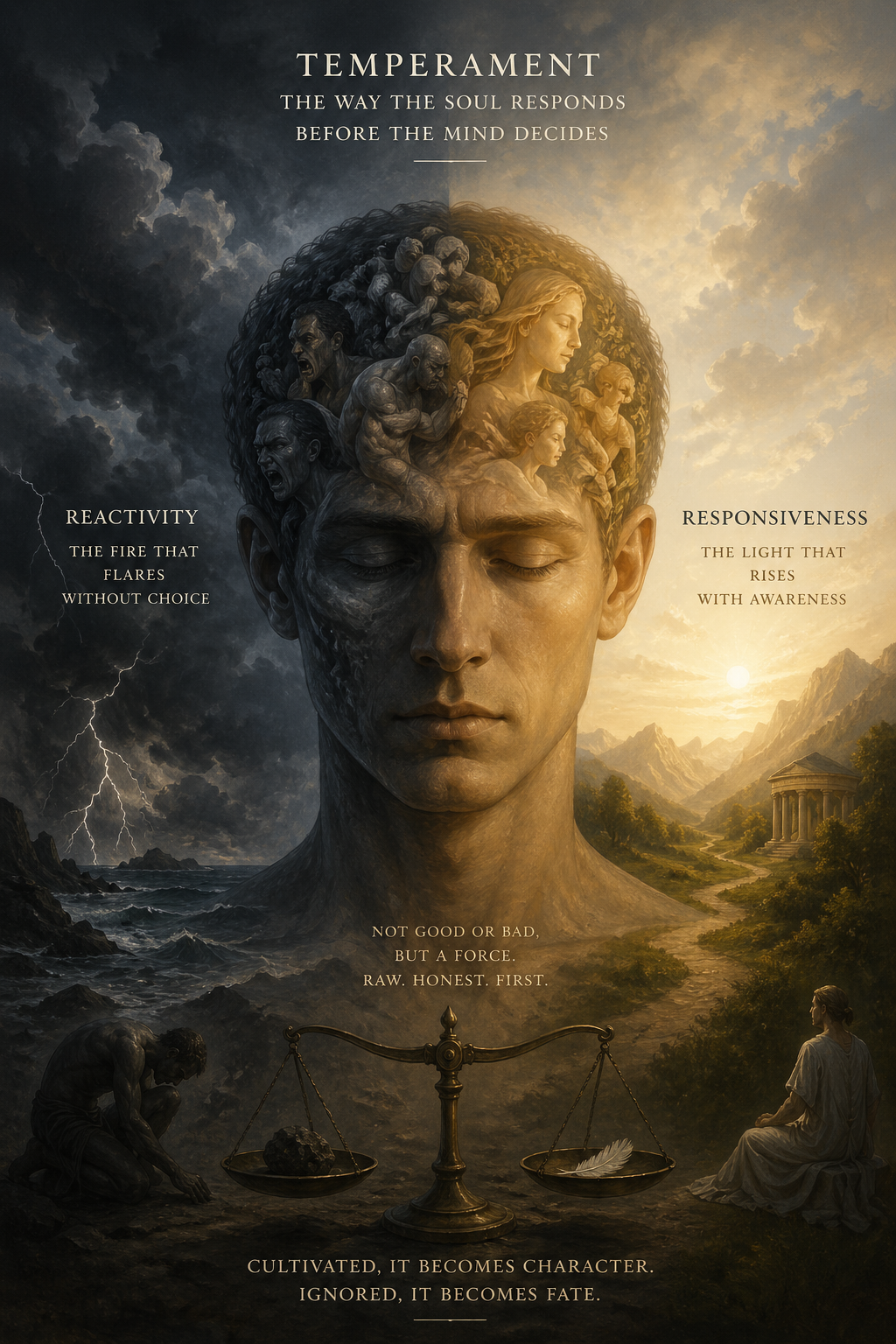
  • Temperament as Memory: What If We Are Not Beginning, But Continuing?

    Temperament as Memory: What If We Are Not Beginning, But Continuing?

    I came across a video recently on infant temperament—how babies express anger, joy, and fear—and I found it fascinating. But as I watched, I couldn’t help but think about how often explanations like this stop at the level of biological process.

    Researchers describe temperament as something biological—early patterns of emotional response associated with brain activity, genetics, and development. Within this framework, neural signals are used to map these differences, suggesting that these tendencies are present from the very beginning—though the question of what they ultimately express remains open to interpretation.

    While that framework offers something valuable, I find myself reaching for a different language—not in contradiction, but in extension.

    A way of understanding that doesn’t reduce these patterns solely to the body.

    What they call temperament, I would describe as something closer to an energy signature—a kind of personalized rhythm of being that the biology reflects, rather than creates.

    In essence, temperament is an expression of consciousness.

    Temperament as an Energy Signature

    Temperament, in this sense, is not just behavior or biology. It is the unique tempo and intensity with which a person meets the world.

    What becomes striking, however, is not just that these differences exist, but that they tend to organize themselves into recognizable patterns. Across individuals, similar orientations reappear—ways of responding, feeling, and engaging that are distinct, yet familiar.

    These patterns have long been described—phlegmatic, sanguine, choleric, and melancholic—as enduring expressions of human temperament, observed with enough consistency over time to suggest that they are not incidental, but structured.

    Historically, these temperaments were not merely personality labels, but attempts to name recurring orientations observed across human experience. In ancient medical and philosophical systems, they were understood as expressions of underlying forces—linked to the body, yes, but not confined to it.

    What do I mean by not confined to it?

    To say that temperament is not confined to the body is to suggest that while it is expressed through the body—through physiology, affect, and behavior—it may not originate there in any complete or final sense. The body becomes the medium through which temperament is made visible, but may not fully account for its source.

    Across time, humans have attempted to map these recurring patterns using different symbolic and conceptual systems. Archetypal frameworks, for instance, organize recognizable ways of being into enduring forms—expressions of energy, orientation, and response that appear across individuals and cultures. Even in astrological traditions, personality is interpreted through structured configurations that attempt to describe tendencies, inclinations, and relational dynamics. While I will not treat these systems as explanatory in themselves, their persistence points to something worth noticing: the repeated recognition that human temperament is patterned, not random.

    But if temperament were only the product of biology or environment, we would expect variation without coherence, difference without repetition, formation without continuity.

    That is not what we observe.

    Instead, we find patterns that reappear with structure. We find dispositions that feel internally consistent from the earliest stages of life. And more importantly, we find expressions of temperament that seem to arrive already organized—before experience has had sufficient time to account for them.

    It is here that the question begins to sharpen.

    If temperament is not fully formed by environment, and not entirely reducible to biology, then what is it we are observing when it appears so early, so distinct, and so consistent?

    This is where the research on children’s past-life memories becomes philosophically unavoidable—not as proof, but as pressure on the limits of our current explanations.

    When examined closely, these cases do not merely present anomalous memories. They present continuity—continuity not only of recollection, but of temperament itself.

    And this is where the argument deepens.

    Because if memory alone were transferred, we might expect fragments—isolated images, disconnected impressions. But what is observed is something far more structured: a coherence of personality. A persistence of preference. A recognizable way of being that extends beyond a single lifetime of experience.

    This is not memory as data.

    It is memory as disposition.

    It is memory as orientation.

    It is memory, expressed as temperament.

    And if that is the case, then what we call temperament may not be something constructed from the ground up, but something carried forward—something that reappears, reorganizes, and expresses itself through new conditions.

    Which means the question is no longer whether temperament exists.

    The question is: what kind of continuity does temperament imply?

    Past-Life Memories and the Continuity of Temperament

    It is difficult to account for a direct memory of an event that one has not personally experienced. Memory, as we understand it, is typically rooted in lived experience—formed through perception, encoded through the body, and recalled through the mind.

    So when we encounter cases in which an individual recalls specific details of a life they have not lived—particularly when those memories are accompanied by the kind of emotional intensity one would expect from direct experience—the question begins to shift. It is no longer simply a matter of whether the memory is accurate, but of how such a memory could exist at all.

    And more importantly—what, exactly, is being carried.

    When viewed through this lens, the research on children’s past-life memories takes on a different weight—not as an anomaly, but as pressure on the limits of our current understanding of memory, identity, and continuity.

    Researchers like the late Ian Stevenson documented cases in which children not only recalled specific details of previous lives, but also exhibited behaviors, preferences, fears, and habits that aligned with those identities in ways that extended beyond what would typically be expected. This work was later continued and expanded by Jim B. Tucker.

    What stands out in these cases is not simply the presence of memory, but the continuity in how that memory is expressed.

    Children have been observed demonstrating skills they were never taught, expressing strong emotional responses tied to specific recollections, and—most notably—showing preferences, habits, and inclinations that align with the personality of the individual they remember.

    In documented cases, once the details of the recalled life are investigated, the child’s behaviors—what they are drawn to, how they react, what they fear, and how they engage with the world—closely correspond with those of that individual. This is not a vague resemblance, but a patterned continuity that reflects a recognizable way of being.

    But the significance of these cases does not rest on memory or behavior alone.

    What becomes most compelling is the persistence of temperament—the continuity of emotional tone and habitual response. It is not just what the child remembers or does, but how they consistently orient themselves toward the world.

    This coherence of disposition suggests that what persists may not be isolated traits, but an underlying structure of personality.

    Not memory as fragments—but memory as form.

    Not memory as information—but memory as orientation.

    If these tendencies endure in this way, then what we may be observing in early childhood is not the formation of temperament, but its re-emergence.

    The body participates in making this experience possible. It provides the structure through which these tendencies can be expressed, regulated, and lived. The brain enables the translation of these patterns into perception, action, and interaction.

    But it may not be the origin.

    It may be the mechanism through which something more intrinsic becomes visible.

    And it is here that the question begins to shift—from observation to experience.

    Not as an abstraction, but as something that can be witnessed directly—before explanation has time to organize it.

    In its earliest form. In real time

    Watching Morpheus

    I watch Morpheus, and I am not simply observing development.

    I am observing patterns.

    I watch for his temperament—his preferences, his reactions, his way of engaging with the world—and I find myself asking not only what is being shaped, but what is already present.

    There are differences I’ve noticed—ones that go beyond what I experienced with my other children. Not just variation, but distinction.

    He doesn’t cry often, but when he objects, there is a clarity to it. A determination that feels directed rather than reactive. It is not random distress, but something that carries intention—as if he is expressing a preference rather than simply responding to discomfort.

    When he is tired, he seeks closeness. Not in a general way, but with specificity. He settles into being held, into being rocked, into a contained presence that allows him to regulate. And when he resists sleep, the sound he makes is consistent—distinct enough to recognize, almost rhythmic, as if it belongs to a pattern rather than a passing moment.

    He shows a clear preference for calm environments. If I speak while breastfeeding, he will pull away or object until the space returns to quiet. It does not feel like sensitivity alone—it feels like selection, as if he is shaping the conditions that allow him to settle.

    From the moment he came home, he has preferred proximity. When placed in the bassinet or crib, he often wakes quickly—not simply alert, but in objection, as though the condition itself does not align with how he experiences rest.

    Not all children respond this way.

    His sister did not. She preferred space. She slept independently and did not seek physical closeness in the same way. And even now, that orientation remains.

    The contrast is not subtle.

    It reveals something that feels important:

    Temperament is not something we impose.

    It is something we encounter.


    Morpheus also moves with a kind of independence that feels innate. He engages with his environment on his own terms, shifting between observation and interaction with an attentiveness that feels active rather than passive.

    He is drawn to certain experiences. Books hold his focus. Classical music settles into him as if it resonates with something already familiar.

    Even physically, from early on, he has resisted passivity. When placed in positions that limit movement, he presses upward—on his legs, through his body—as though trying to meet the world from a different orientation. At five months old, he is already army crawling across his play mat. There is effort in it. Direction. Not simply discomfort, but preference expressed through the body.

    He is deeply social. When new people are introduced, he smiles, laughs, coos, and studies them with a kind of attentiveness that feels engaged rather than incidental.

    And then there are moments that are harder to name.

    At times, he looks at me in a way that feels… knowing.

    Not just recognition in the ordinary sense—but something steadier, more sustained. As if I were not entirely new to him.

    I hesitate even in saying that, because language reaches its limits here. Of course, he knows me—I am his mother. But this feels different. Not learned. Not developing. Just… present.

    There are moments when I sense what he needs before he expresses it. I respond, and he meets me there—smiling, vocalizing, as if we are already in conversation. Not in words, but in something more immediate.

    Even in small, ordinary moments, there is a kind of intention.

    One night, his father came into the bathroom to tell me that Morpheus’ eyes were already closing—that he would be asleep before I finished my shower, and that I didn’t need to rush to feed him. At that moment, Morpheus opened his eyes, as if he had heard and understood, and stayed awake until I returned. Not distressed. Not unsettled. Simply… waiting.

    It is subtle. But it is consistent.

    There is something in him that does not feel newly formed.

    It feels carried.

    When viewed through this lens, temperament begins to take on a different meaning.

    It is no longer just a developmental starting point, shaped over time by environment and experience. It begins to look like continuity—something that arrives with the child rather than emerging from nothing.

    This is what makes the research on children’s past-life memories so difficult to dismiss.

    In documented cases, children have not only recalled specific details of lives they could not have learned through ordinary means, but have also exhibited patterns of behavior—preferences, fears, skills, and emotional responses—that align with the individuals they describe.

    What stands out is not memory alone, but coherence.

    The way a child moves through the world—their temperament, their inclinations, their habitual responses—often mirrors the life they recall in ways that extend beyond isolated traits. It reflects a continuity of expression.


    I do not claim certainty.

    But when I watch Morpheus—his preferences, his rhythms, the way he meets the world, and the moments that feel unmistakably familiar—I cannot ignore the possibility that what I am seeing is not the beginning of a personality, but the reappearance of one.

    And whether that is understood through biology, environment, or something beyond both, what remains is this:

    He is not neutral.

    He is not waiting to become.

    He is already expressing a way of being.

    Which brings me back to the question I cannot seem to let go of—

    When we observe temperament in its earliest form, are we witnessing something being formed…

    Or something being revealed?

    Parenting as Attunement

    If what we call temperament is an expression of something deeper—something intrinsic—then parenting begins to shift in a fundamental way.

    It becomes an act of attunement.

    Less about shaping, more about seeing.

    Not the construction of a person, but the careful recognition of one.

    It asks us to observe without immediately interpreting, to guide without imposing, and to remain aware that what we are witnessing may not be the beginning of who they are, but a continuation.

    And in that awareness, we are invited into a different kind of responsibility—to slow down enough to truly observe who a child already is. And in doing so, we begin to recognize that our role is not to override their nature, but to meet it with clarity. To support it. To allow it to find expression without distortion.

    And perhaps, in that shift, we are doing more than raising children.

    We are learning how to relate to consciousness in its earliest, most honest form.

    If this reflection resonated with you, I invite you to sit with one question this week:

    Where in your child, or in yourself, have you mistaken temperament for behavior, when it may have been something deeper asking to be recognized?

    Join the Substack Chat Here

    Rhonda Reliford Avatar

    Work with Me

    Explore The Depths of Consciousness In Deeper Transformation Work