
Discover how childhood, culture, and religion shape the way we love — and how awareness and emotional intelligence can free us from repeating old patterns.
Developmental psychology and attachment theory suggest that our earliest relationships — especially those with caregivers — shape our internal working models of love, trust, safety, and closeness. What we observed between parents, caregivers, or early role models becomes the baseline of what feels “normal.” Sometimes that normal is healthy, grounding us in stability. Other times, it is distorted, where unhealthy behaviors take root and are mistaken for love, loyalty, or devotion.
These models guide how we perceive and behave in adult relationships. While early bonds do not rigidly determine adult dynamics, they form patterns and expectations that often echo throughout one’s lifetime.
Echoes of Childhood in Adult Love
Think back to when you were a child. What were the experiences that made you silently vow, “I will never let that happen in my life.” For me, it was domestic violence — I promised myself I would leave before enduring that. I also swore I would never marry a man who struggled with addiction.
What took me years to understand is that repeating patterns isn’t always about reliving the same external experiences. More often, it’s about how we respond to conflict — our coping strategies, our reactivity to what unfolds, and the defensive postures we adopt to protect ourselves. Essentially, it’s not the specific event that matters, but the way our conditioning shapes our response to it — how we’ve learned to show up in moments of conflict, no matter the form they take.
Tracing the origin of a pattern can deepen our understanding of our experiences. It helps us understand why we respond as we do. But, what ultimately matters most is our willingness to recognize the patterns that continue to reveal themselves. Awareness gives us the power to shift how we show up and what we allow into our field of experience.

Awareness is the act of mindfulness, to be aware of and present in the current moment, with the capacity to observe ourselves with honesty and curiosity, to notice the subtle ways our patterns play out without collapsing into them. Awareness is not about self-criticism or hyper-vigilance, and it is not about labeling ourselves in any capacity.
It is about recognizing the currents we swim in so we can choose how to move. Awareness creates the pause between stimulus and response and is where freedom begins. To ground this in lived experience, here are a few patterns that often go unnoticed
The patterns that follow are not exhaustive, nor are they meant to reduce us to categories. They are simply some of the most common ways early lessons echo in adulthood. When we can see them clearly, we open the possibility of responding differently.
Ten Common Patterns We Mistake for Love
Caretaking as Identity
Children who were parentified (taking care of siblings or emotionally supporting parents) often equate love with self-sacrifice. In adult relationships, they neglect their own needs and over-function, leading to imbalance and burnout.
Conflict Avoidance
If a child grows up in a home where conflict is either explosive or never resolved, they learn to avoid disagreements at all costs. As adults, they equate silence with safety, even when it breeds resentment.
Conditional Love
When love was given only for achievements, compliance, or “being good,” children internalize worth as performance-based. In relationships, this manifests as perfectionism, people-pleasing, or fear of rejection.
Distrust and Hyper-vigilance
Growing up in unpredictable or unsafe environments can wire children to expect betrayal or instability. Later, this creates patterns of suspicion, checking, or needing constant reassurance.
Emotional Suppression
In households where vulnerability was unsafe (“don’t cry,” “be tough”), children learn to disconnect from emotions. As adults, they shut down or struggle to empathize, perpetuating distance in intimacy.
Fear of Abandonment
Children of emotionally unavailable or absent parents often carry deep abandonment wounds. In adulthood, they cling, over-attach, or accept unhealthy dynamics just to avoid being left.
Inconsistent Boundaries
Children who grew up without clear boundaries (e.g., parents oversharing, lack of privacy, or enmeshment) struggle with healthy boundaries later. They can either repeat enmeshment or swing to the opposite extreme — rigid detachment.
Jealousy and Possessiveness
If a child saw love modeled as control, dominance, or jealousy, they learn a flawed concept of love. They think, “if they don’t get jealous, they don’t love you.” As adults, they mistake insecurity for passion in relationships.
Normalization of Criticism
A child raised in a critical environment internalize harshness as normal communication. In adulthood, they unconsciously criticize their partner — or accept criticism as love — because it feels familiar.
Silent Treatment and Withdrawal
Children who observed caregivers using withdrawal as punishment tend to mimic the same behavior. They shut down or stonewall to regain control or avoid intimacy.
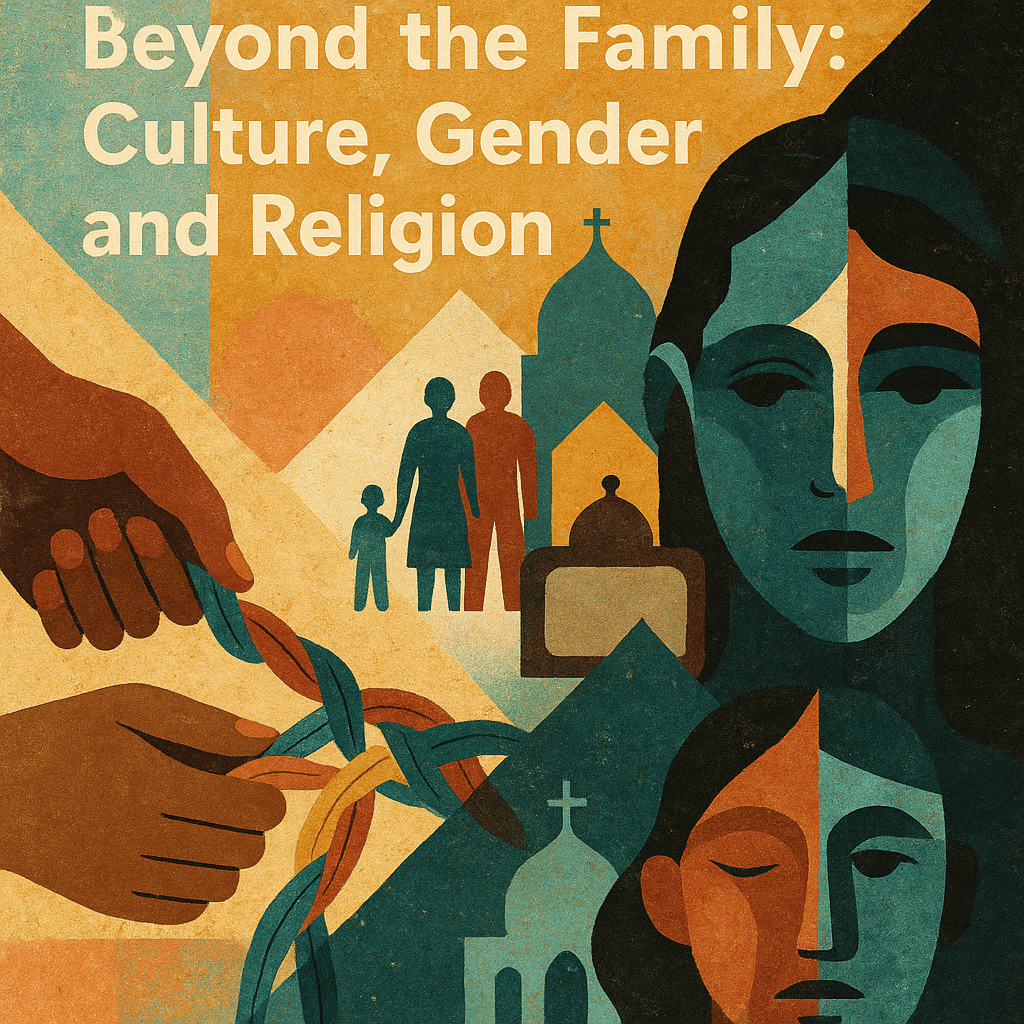
I’ve observed these behavioral patterns not only in my professional work. I also see them in the ordinary rhythms of life. They commonly occur among friends, family, and the broader society we inhabit. They are far from rare. In fact, they are so deeply woven into the fabric of daily experience that they often go unnoticed. They are embedded in family structures and passed down through generations until they saturate our collective worldview. What we call “normal” is rarely neutral; it originates within the household but is continually reinforced by the larger culture. This reciprocal influence — between family life and the institutions, traditions, and myths that surround it — shapes our understanding of what it means to be human. It is within this dynamic that we see how powerful patterns of thought and behavior are transmitted, repeated, and normalized.
Of course, it’s not really a matter of which came first, family or society. Rather, they shape one another in a continuous loop: institutions, religion, schools, media, and economic systems condition how families behave, while family practices in turn reinforce cultural norms. What matters most is recognizing these patterns within ourselves and in the life unfolding around us.
Gender, Religion, and Cultural Myths in Love
We can see these dynamics clearly in the way society has constructed gender, religion, and cultural ideals. These are not the only examples, but they illustrate how deeply conditioning operates.
Gender Roles and Silent Expectations
Gender roles often script our sense of identity before we can even name it. At times, they give structure or clarity, but they also narrow what feels possible. Roles that reward self-sacrifice can make caretaking feel virtuous, even when it erases the self. Masculinity is often tied to dominance or stoicism, teaching boys that vulnerability is weakness. Femininity is equated with beauty, compliance, or nurturing, reducing women’s worth to what they provide for others. Parental roles are narrowly drawn: fathers as disciplinarians and providers, mothers as reconcilers and caretakers. These lessons may seem ordinary. Yet, they quietly shape how we show up in love. Often, they constrain intimacy rather than expanding it.
Religion’s Double Edge
Just as gender roles narrow our sense of self, religious frameworks can also shape how we love and how we endure. At their best, spiritual traditions offer community, guidance, and meaning. Yet when interpreted through fear or control, they can reinforce patterns that limit growth. Teachings that valorize suffering romanticize endurance over self-advocacy. Purity codes can frame natural desires as shameful, teaching us to equate devotion with denial. Stories of divine punishment model obedience through fear, while verses like “He is a jealous God” risk recasting insecurity as a form of love.
When spirituality is distorted, these lessons deepen. Some guru systems discourage questioning, equating doubt with betrayal. Certain prosperity teachings link holiness to material gain, while ascetic doctrines can suggest that detachment from human bonds is the only path to enlightenment. Each of these narratives shapes how individuals understand love, loyalty, and worth — often embedding submission or suppression as the price of belonging.
Cultural Myths and Media Messages
Cultural myths and media archetypes extend these lessons into the broader world. Familiar phrases — “boys don’t cry,” “no pain, no gain,” “pull yourself up by your bootstraps” — glorify toughness and denial. Media presents us with the stoic cowboy, the selfless mother, and the warrior hero. These archetypes normalize silence, sacrifice, and endurance as noble. While these stories can inspire, they also normalize emotional suppression and discourage vulnerability. In this way, cultural scripts blend into the personal narratives we inherit at home. They reinforce the belief that suppression is strength. They suggest that humanity must be constrained to be acceptable.
Awareness as Liberation
What becomes clear is that these systems — family, gender, religion, and culture — do not simply shape how we love; they shape how we think about love. They script endurance as virtue, suppression as strength, and fear as devotion. Awareness is what interrupts these inherited scripts. It invites us to pause, to see them for what they are, and to reclaim the freedom to love and live in ways that expand rather than diminish us.
True strength emerges not from blind endurance but from awareness: the ability to recognize emotions as they arise, understand their origins, and navigate them with intention. This capacity transforms reaction into choice. Setting boundaries around what we are willing to experience is not weakness; it is power.
Awareness asks us to recognize both the intimate systems we inherited and the broader cultural scripts that distort how we love and how we justify love’s distortions.
Emotional Intelligence in Relationships as Evolution
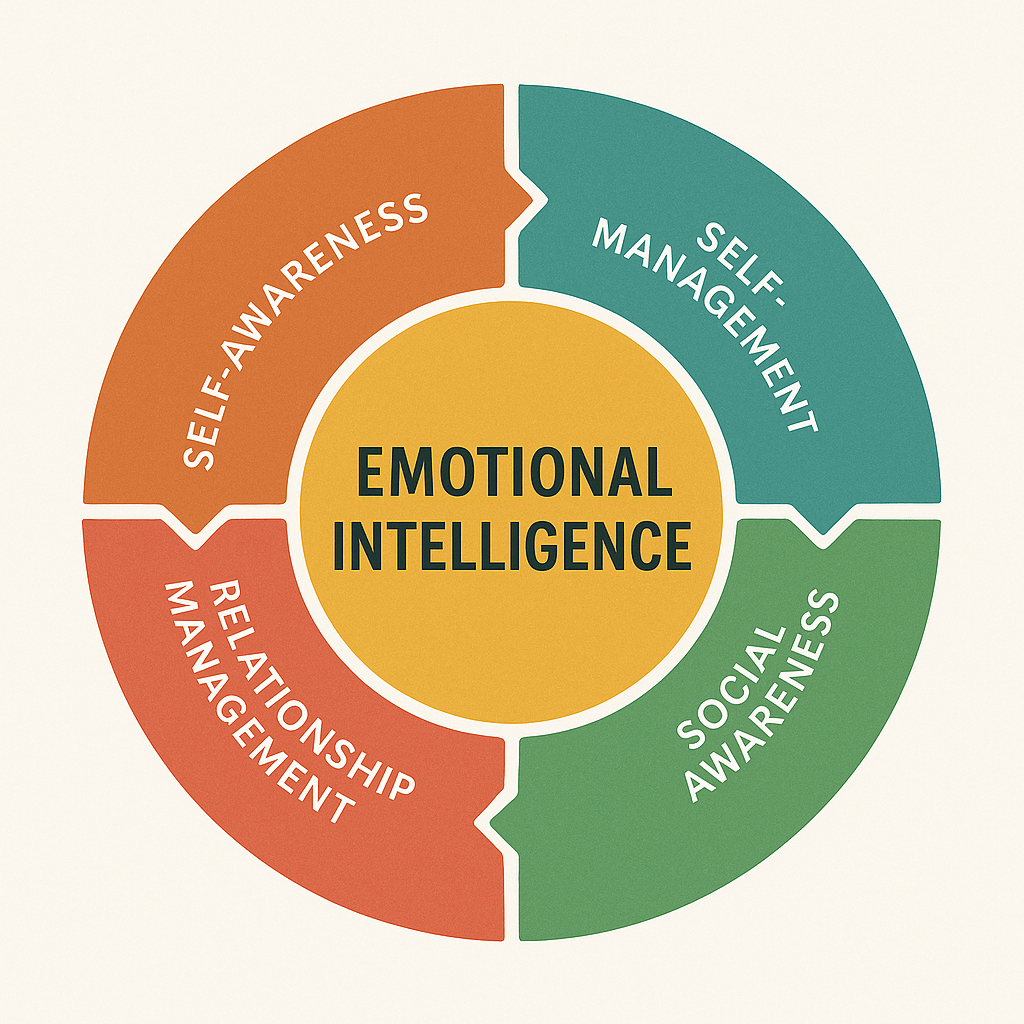
Psychology now gives language to this ancient truth. The framework of emotional intelligence — a relatively recent but transformative development — provides a structure for practicing awareness. Emotional intelligence cultivates the pause between stimulus and response, helping us notice without collapse, regulate without suppression, and connect without losing ourselves. Research shows that individuals with higher emotional intelligence are better equipped to manage conflict, sustain intimacy, and navigate complexity. In this way, emotional intelligence signals more than a skillset; it signals an evolution. We are not only learning new ways to live day to day — we are reshaping the very way we experience reality.
Toward Collective Transformation
Awareness, then, is not only a personal liberation but a collective one. Each time we recognize and rewrite the scripts we inherited, we chip away at the larger systems that depend on silence, submission, or fear. As emotional intelligence deepens at the level of families, workplaces, and communities, it reshapes what love looks like in the public sphere — how we resolve conflict, how we lead, how we create belonging. To rewrite the story of how we love is to rewrite the story of who we are becoming: a humanity that no longer confuses suppression with strength, nor normalizes criticism, withdrawal, jealousy, or other distortions as love. As we start to recognize awareness as the ground of freedom, connection, and transformation, we also open ourselves to the fullness of the human experience — to its nuance, its chemical and emotional currents, its psychological unfolding, and the imprint of our past. Only then can we honor what it truly means to be human: not beings trapped in inherited scripts, but conscious participants in shaping love, belonging, and life itself.
Want more? Read this essay and others on my Substack newsletter.
 Echoes from the Circle