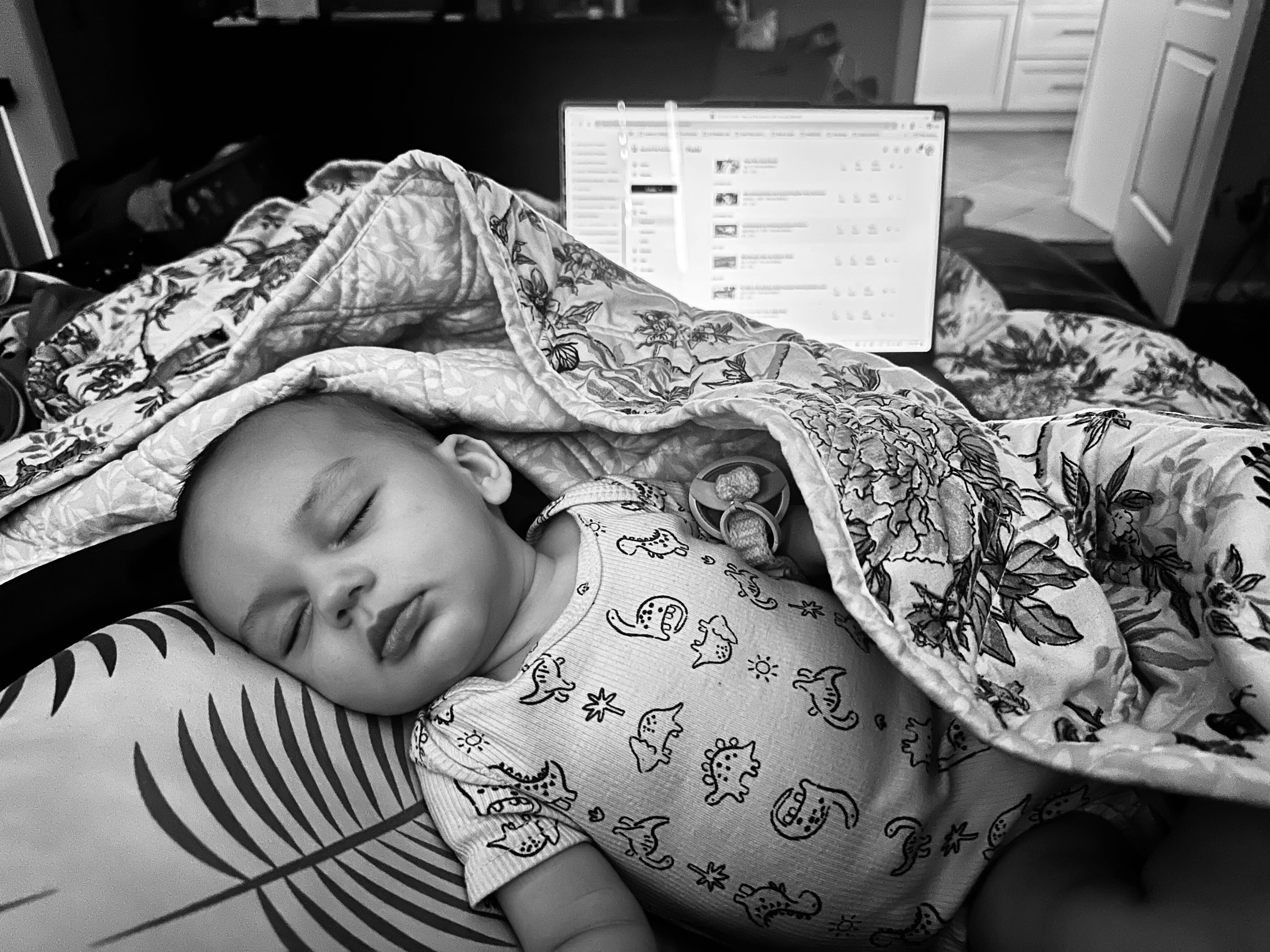
Author: Rhonda Reliford

  • When Déjà Vu Feels Like a Past-Life Memory

    When Déjà Vu Feels Like a Past-Life Memory

    There is a memory you have. You know the one.

    It arrives without warning: a smell, a particular quality of afternoon light, or notes in a song, and suddenly you are somewhere else entirely.

    Flooded.

    Fully there.

    Not remembering, but experiencing.

    And for a moment, time works differently.

    The body is here, standing in the present. But something in you has slipped beyond the ordinary order of things. The past is not behind you. It is present. It has texture. Temperature. Emotion. Atmosphere. The moment does not arrive as information. It arrives as experience.

    For a few seconds, the soul remembers what the clock forgets.

    That is what happened to my husband in the summer of 2023.

    We were just exiting our tour of Castel Sant’Angelo, just before the path began to open onto the bridge lined with angels.

    I was a little ways off, corralling the kids and waiting for him to join us.

    It was one of those ordinary family moments that, in hindsight, feels almost strangely arranged. The kind of moment that gives no warning that it is about to become part of your life’s mythology.

    Everyone was talking at once, the way families do when they are excited and trying to take in everything around them. Cameron tilted his head toward the music and said it sounded weird. Mariyah, always ready to clarify, pointed out that it sounded different because it was a bagpipe. Maximus, still young enough to be equally impressed by Rome and dessert, kept asking for gelato with complete determination. I told him we would walk down and get one, half-listening to him, half-listening to the strange music winding through the air.

    Tourists moved around us. The city breathed in its usual way. Rome was alive with stone, sound, heat, history, and motion.

    I turned to look at James as he walked toward us. His expression had shifted.

    “Whoa,” he said. “That was weird. I just had the weirdest déjà vu.”

    I started to respond casually, to tell him that something similar had happened to me two days earlier in Naples. But within a fraction of a second, something unexpected happened.

    Whatever had moved through him did not pass over him lightly. It took hold.

    He broke down crying.

    A deep, emotional cry.

    Not tearing up.

    Sobbing.

    This was very much out of character for him. Tourists were all around us, and there was my husband — six feet tall, muscular, usually composed — relentlessly sobbing in the middle of Rome.

    The kids laughed at first, confused by its suddenness. I was confused too. Nothing obvious had happened. No one had said anything. There was no visible reason for the emotion moving through him.

    I moved closer toward him, both to comfort him and to understand what had just happened. “Babe, what’s wrong?”

    Through tears, still heaving, he tried to explain it.

    “It felt like déjà vu, but different. It was different than any déjà vu I have ever experienced. It was a memory. I was standing in this exact same spot, but everything was different. Everything and everyone from the present moment were gone. It was just an empty space. And I felt like I should be there and not here in the present with you guys.”

    That sentence stayed with me.

    “Not here in the present with you guys.”

    There was something unsettling in it, not because it sounded detached from us, but because it sounded like a deeper part of him had momentarily recognized another belonging.

    It was one of those rare moments when the conditions seemed to arrange themselves perfectly. His mind was not weighed down by everyday troubles. He was not distracted. He was fully present, standing in the open air of Rome while Scottish bagpipes played somewhere in the distance.

    And then something opened.

    He described seeing himself as a tall, slender Italian man, dressed for another era, looking across the vast, empty land, alone in that place before the modern structures surrounded it.

    What overwhelmed him most was not the vision itself.

    It was the feeling.

    The emotion moving through him was undeniable. As he spoke, the sadness from a life lost poured from him. This was not ordinary sadness. It was recognition. Longing. Grief. A sense of being separated from a life that, in some deep and inexplicable way, still felt like his.

    He missed the lifetime he had left behind.

    He was confused by it. Shaken by it.

    The experience itself lasted only a few moments, but its emotional force has stayed with him.

    Before that day, my husband had always been the skeptic.

    He was willing to listen. He was willing to hear people out. But he was not someone who reached quickly for spiritual explanations. He was not searching for proof of reincarnation. He was not looking for signs, messages, or hidden meanings. If anything, before this moment, he leaned closer to the belief that perhaps this life was all there was.

    Then Rome happened.

    And after that day, he was not the same kind of skeptic.

    He did not walk away with a theory.

    He walked away with a memory.

    Or at least, with the undeniable feeling of one.

    The Signs Before the Memory

    What struck me later was how much of his life had already been pointing toward Rome before either of us had the language for it. Long before we ever stood near Castel Sant’Angelo, Italy had lived somewhere in him. Even when I first met him, he told me he was Italian. He wasn’t. He was young, and maybe he didn’t know how else to explain it, but he said he had always felt Italian. At the time, it sounded like the kind of thing a young person says when another culture feels more interesting, more beautiful, or more alive than their own. But years later, standing in Rome, I understood it differently.

    His fascination with Italy had never been casual. It showed up in the places he dreamed of seeing, the stories that captured him, and even in the tattoos he chose to carry on his body. They were not random images. They carried symbols of longing, direction, memory, and return: a ship, a lighthouse, a map marked by Rome, and a gladiator with the Colosseum rising in the background. Looking back, those images feel less like decoration and more like fragments of a language his soul had been speaking long before either of us knew how to translate it.

    On their own, each of these details could be explained away. A childhood fascination. A favorite place. A tattoo chosen for its beauty or symbolism. But when placed beside one another and then held against what happened at Castel Sant’Angelo, they begin to feel like something more than coincidence. They feel synchronistic, as if separate pieces of his life had been quietly arranging themselves around Rome long before the memory ever surfaced.

    For the summer of 2023, our month in Europe was mostly around Spain and Portugal, the countries I loved most. Rome was something I worked into the trip for him. I knew how much he longed to visit Rome; I wanted to make that dream a reality.

    When planning our trip, I focused on things I thought he would love, mostly the Colosseum. I spent days trying to get those tickets.

    View of the Colosseum and surrounding Rome cityscape with St. Peter's Basilica in the background
    A panoramic view of Rome featuring the Colosseum and St. Peter’s Basilica

    But Castel Sant’Angelo was not on our itinerary at all.

    That is part of what makes the moment so striking to me now.

    We departed from Naples later than planned that day, causing us to arrive in Rome nearly three hours behind schedule. Because of the delay, we missed another event I had carefully planned. By the time we finally reached our apartment, dropped off our bags, and settled in, the day had already shifted away from the itinerary I had made.

    We were no longer following the plan.

    We were in that strange in-between space travel sometimes creates, where the schedule has fallen apart, and all you can do is respond to what is still possible.

    I pulled up the map.

    Castel Sant’Angelo was only ten minutes away.

    It would be closing soon, but we still had about two hours. At the time, it felt like a small, practical decision. It was close. It was still open. It gave us somewhere to go after the plan we had lost.

    I remember thinking, Hmm, this isn’t on our itinerary. Let’s give it a shot.

    And just like that, without intention, without research, without any sense that we were walking toward something important, Castel Sant’Angelo became one of the first places we visited in Rome.

    Looking back, that casual decision feels less casual than it did then.

    Because of all the places we could have gone first, we ended up there.

    Not the event I had planned.

    Not the Colosseum, which I had carefully built into the trip for him.

    Not the Vatican, though we were staying nearby.

    Not one of the famous piazzas, fountains, or ruins.

    Castel Sant’Angelo.

    A place left off the itinerary.

    A place we only considered because early morning circumstances caused us to be late, the original plan had collapsed, our apartment happened to be nearby, and the closing time left just enough room for us to go.

    That is often how synchronicity seems to move. Not by making life unfold perfectly according to our plans, but by disrupting the plan just enough to lead us somewhere we did not know we needed to be.

    At the time, we thought we were making the best of a delayed morning and a missed event.

    Afterward, it felt as though the delay had redirected us. As though the missed plan had made space for the real arrival.

  • Why Bergson May Give Us the Best Language for Near-Death Experiences

    Why Bergson May Give Us the Best Language for Near-Death Experiences

    Most of us are taught to think of time as a line.

    Birth is the beginning. Death is the end. The past is behind us. The future is ahead of us. The present is a tiny point we are standing on, moving forward one second at a time.

    But Henri Bergson saw time differently.

    For Bergson, real time is not a line at all. It is not a series of separate moments stacked one after another. Real time is lived. It flows. It gathers. It deepens. It carries the past forward into the present, not as something dead and gone, but as something still active within us.

    He called this duration.

    And I believe Bergson’s concept of duration may be one of the most powerful tools we have for understanding near-death experiences, memory, identity, and the possibility that consciousness is not simply produced by the brain.

    Bergson gives us a way to think about the self as more than the body, more than the brain, and more than the narrow slice of awareness we call ordinary waking consciousness.

    He gives us a way to ask a deeper question:

    What if who we are is not contained in a moment?

    What if identity is not fixed to this one lifetime, to the name we answer to, or to the body we wear, but a continuity? A multitude of lifetimes, of names, and a diversity of identities.

    What if the self is not something the brain creates but something the brain helps organize, filter, and bring into action?

    The Problem With How We Usually Think About Time

    Modern life trains us to think of time mechanically.

    We measure it by clocks, calendars, schedules, deadlines, birthdays, anniversaries, and timelines. We divide life into neat categories: childhood, adolescence, adulthood, and old age. We speak as though the past is somewhere behind us, stored away like a file in a cabinet.

    But this is not how we actually experience ourselves.

    A smell can bring back a childhood memory so vividly that, for a moment, the past feels present. A song can return us to a version of ourselves we thought we had outgrown. A fear we cannot explain may shape our decisions before we even have language for it. An old wound may live in the body long after the event itself has passed.

    This tells us something important.

    The past is not simply “over.”

    It is still moving in us.

    Bergson understood this. His concept of duration describes time as an inner flow where the past and present interpenetrate. The present is never merely the present. It is saturated with memory, feeling, perception, habit, and the accumulated movement of everything we have lived.

    This means identity is not a snapshot.

    Identity is a continuity.

    You are not simply who you are in this moment. You are the living accumulation of all that has shaped you, all that has moved through you, all that has been carried forward in consciousness.

    The Memory Cone: Why We Are More Than What We Remember

    One of Bergson’s most important images is the memory cone.

    In simple terms, imagine your entire past as a vast field of memory. At the widest part of the cone is the fullness of your past. The deep, expansive totality of lived experience. At the narrow point is the present moment, where memory becomes useful for action.

    Most of the time, we do not access the whole cone. We only draw from the memories we need in order to function.

    We remember where we put the keys. We remember how to drive. We remember the name of the person standing in front of us. We remember enough to act.

    But Bergson’s framework suggests that memory is not merely stored in the brain like data in a machine. Instead, the brain helps select what is useful from a much larger field of memory. In Matter and Memory, Bergson argued that the brain is tied to action and practical orientation, rather than being the total producer of consciousness itself. His work is often read as challenging the simple idea that memory is merely deposited inside the brain.

    This matters deeply.

    Because if memory is not just a physical storage system, then the self may not be reducible to neural activity.

    The brain may be less like a generator and more like a receiver, filter, organizer, or instrument.

    This does not mean the brain is unimportant. It is profoundly important. It gives consciousness a way to operate in the physical world. It allows us to perceive, choose, move, speak, and respond. But Bergson’s framework leaves open the possibility that consciousness exceeds the brain’s ordinary function.

    And this is where near-death experiences become so significant.

    Near-Death Experiences Challenge the Usual Model

    Near-death experiences are difficult to dismiss because many are reported after cardiac arrest, when the heart has stopped, circulation has ceased, and the brain is no longer receiving the oxygenated blood required for ordinary conscious experience.

    At a time when psychological features would be expected to cease functioning, people report leaving the body, seeing themselves from above, feeling dissociated from the body, and observing the events unfolding around them. Many describe moving through light. Encountering deceased loved ones. Experiencing a panoramic life review. Feeling a love or intelligence beyond ordinary language. Knowing that everything is connected. Returning with a transformed understanding of life, death, purpose, and identity.

    Bruce Greyson, one of the most prominent researchers in the field, has studied over a thousand near-death experience cases and has documented how profoundly these experiences can alter a person’s values, beliefs, attitudes, and personality. The University of Virginia’s Division of Perceptual Studies notes that Greyson’s work has also explored why NDEs cannot be easily dismissed as simple dreams or hallucinations.

    This does not mean we should be careless with claims.

    It does not mean every near-death account proves life after death.

    But it does mean the phenomenon deserves a larger framework than the one we usually give it.

    If consciousness is only what the brain produces, then near-death experiences become hard to explain, especially when people report heightened clarity, meaningful memory, and expanded awareness during states of bodily crisis.

    But if consciousness is filtered through the brain, Bergson suddenly becomes incredibly relevant.

    Near-death experiences seem to allow the ordinary filters to loosen.

    The Brain as Filter, Not Source

    This is one of the reasons Bergson’s work matters so much.

    He gives us a philosophical structure for thinking about consciousness as something that may not originate inside the brain, even though it operates through the brain during embodied life.

    In ordinary life, the brain narrows consciousness toward survival and action.

    We cannot walk around every day perceiving the whole of existence. We cannot live fully open to every memory, every possibility, every dimension of meaning. We would be overwhelmed. So consciousness contracts. It focuses. It selects.

    The brain helps us function.

    But what happens when the body is close to death?

    What happens when the usual action-oriented function of the brain is disrupted?

    What happens when consciousness is no longer being organized primarily around survival in the physical world?

    This is where Bergson’s memory cone becomes more than a philosophical image. It becomes a way to understand why people near death often describe an expanded awareness of their entire lives, a review of their actions, and a sense that every moment mattered.

    Perhaps the life review is not the brain inventing a final dream.

    Perhaps it is consciousness accessing more of the cone.

    Perhaps the dying process loosens the narrow point of practical attention and opens awareness into a larger field of memory.

    This would explain why near-death experiencers often describe their life review not as a sequence of memories, but as a total experience. They do not simply remember events. They feel the meaning of those events. They feel how their actions affected others. They experience identity as relational, moral, energetic, and continuous.

    That matters.

    Because the life review suggests that identity is not merely what we tell ourselves about who we are.

    Identity may be the total movement of consciousness through time.

    Continuity of Identity

    The question of identity is usually framed too narrowly.

    We ask: Am I the same person I was as a child?

    At one level, the answer seems obvious. Yes and no.

    My body has changed. My beliefs have changed. My relationships have changed. My understanding of life has changed. Yet there remains a continuity. Something carries through.

    Bergson helps us understand this.

    The self is not the same because it remains fixed. The self is the same because it endures. It changes without becoming entirely separate from what came before.

    That is duration.

    We are not static beings moving through time. We are beings made of time. We are layered, accumulated, and unfolding. The past is not behind us; it is within us, pressing into the present, shaping what we perceive, fear, desire, choose, and become.

    This is why Bergson may be so important for understanding not only near-death experiences, but also healing, transformation, trauma, intuition, and even the possibility of past-life memory.

    Researchers at the University of Virginia have also studied children who report memories of previous lives, including cases investigated by Jim Tucker and the late Ian Stevenson. The Division of Perceptual Studies presents these cases cautiously, noting that some are more compelling than others, but they remain significant because they raise difficult questions about memory, identity, and consciousness beyond the ordinary lifespan.

    What is memory, if it can appear to exceed the individual brain?

    And what is identity, if consciousness carries more than the present personality can explain?

    Why Bergson Is Better Than a Purely Materialist Explanation

    A strictly materialist framework often begins with the assumption that consciousness is produced by the brain. From that view, everything we experience—love, memory, intuition, mystical states, near-death experiences, and spiritual insight—must ultimately be reduced to brain activity.

    The problem is not that the brain is irrelevant.

    The problem is that reductionism often explains the mechanism while missing the meaning.

    It can describe neural activity, but it struggles to explain why experience feels like something from the inside. It can track brain states, but it cannot fully account for the richness of subjectivity, the continuity of identity, or the transformative power of near-death experiences.

    Bergson does not deny the body.

    He does not reject science.

    He simply refuses to collapse consciousness into matter.

    That is why his framework is so useful. It allows us to hold both realities at once: the body matters, and consciousness may exceed the body.

    The brain shapes our access to consciousness, but it may not be the ultimate origin of consciousness.

    The body gives consciousness a location, but it may not define its full nature.

    Memory supports action in the world, but it may also belong to a deeper continuity of being.

    This is a more spacious model.

    And it fits the evidence of lived experience better.

    Near-Death Experiences as a Glimpse Into Duration

    When people return from near-death experiences, they often say the experience felt more real than ordinary life.

    That detail matters.

    They are not usually describing confusion. They are describing clarity. They are not simply saying they had a strange dream. They are saying they encountered a dimension of reality that reorganized their understanding of existence.

    Many return less afraid of death. Many become more compassionate. Many become less attached to superficial measures of success. Many feel that love is not sentimental but fundamental. NDE research has emphasized the lasting aftereffects of NDEs on people’s beliefs, values, and personalities.

    From a Bergsonian perspective, this makes sense.

    A near-death experience may be a moment where consciousness is no longer bound to the narrow demands of ordinary action. The person is not trying to get through traffic, answer emails, manage appearances, or perform an identity. The ordinary structures loosen.

    And what appears?

    A wider field.

    A deeper continuity.

    A self that is not limited to the social personality.

    A memory of life that is moral, relational, and alive.

    A sense that consciousness does not move in straight lines but in depth.

    This is duration.

    Not time as clock-time.

    Time as living continuity.

    Time as the soul’s accumulation.

    Time as the ongoing movement of being.

    Why This Matters for How We Live

    The point of exploring Bergson is not only to think differently about death.

    It is to live differently now.

    If we are continuums, then every moment matters.

    Not because we should become afraid of making mistakes, but because our lives are always becoming part of us. Every choice enters the stream. Every wound asks to be understood. Every act of love expands the field. Every pattern we refuse to examine continues moving through us until we bring consciousness to it.

    This is why healing is not simply about “moving on.”

    We do not move on from the past as though it disappears.

    We metabolize it. We integrate it. We transform our relationship to it. We bring the hidden structures of the self into awareness so that they no longer govern us unconsciously.

    Bergson helps us see that the past is not dead weight.

    It is living material.

    And consciousness is not a flat surface.

    It has depth.

    This is also why transformation is possible. If identity were fixed, we could not change. But if identity is duration, then we are always participating in our own becoming.

    We are shaped by what has been, but not imprisoned by it.

    The past lives in us, but it does not have to rule us.

    The self endures, but it also evolves.

    The Continuity of Being

    This theory may not give us a complete map of what happens after death.

    But it gives us something profoundly important: a language for continuity.

    It gives us a way to understand why memory feels deeper than recall. Why identity feels larger than personality. Why consciousness may not be reducible to the brain. Why near-death experiences feel less like hallucinations and more like encounters with a deeper order of reality.

    This framework does not flatten mystery.

    It protects it.

    And in a world that often wants to reduce human beings to biology, productivity, or social identity, Bergson reminds us that we are not merely machines moving through measurable time.

    We are layered beings.

    We are living continuities.

    We are memory, perception, body, spirit, action, and becoming.

    Near-death experiences may be startling because they reveal what ordinary life conceals: that consciousness is not as narrow as we think, that identity may be deeper than the body, and that death may not be the destruction of the self, but a transformation in how consciousness relates to time, memory, and being.

    Bergson does not ask us to abandon reason.

    He asks us to expand it.

    And perhaps that is exactly what we need.

    Because if duration is real, then life is not a series of disconnected moments.

    It is a continuous unfolding.

    And if consciousness endures, then who we are may be far greater than the brief surface of this life can fully reveal.

  • The Limits of Proof and the Nature of Consciousness

    The Limits of Proof and the Nature of Consciousness

    We Dismissed the Man Who Saw the Whole Picture

    What happens when the truth about consciousness arrives a century too early, and what does it cost us to ignore it?

    Imagine you have a vivid, unshakeable sense that something enormous is true. Not because someone told you. Not because you read it in a textbook. But because you have felt it — maybe in a moment of grief, or wonder, or during one of those rare flashes of clarity where the world goes quiet and something deeper speaks. You know, with every cell in your body, that you are more than your brain. That your memories are not simply stored in neurons like files on a hard drive. That consciousness — whatever it is — is bigger, stranger, and more continuous than the materialist story allows.

    Now imagine trying to prove that in a room full of scientists.

    This is roughly the position Henri Bergson found himself in at the turn of the 20th century — and, honestly, it’s the position many of us find ourselves in today whenever we try to talk seriously about metaphysics, the transpersonal, and altered states. It’s like running into a brick wall at top speed, on purpose.

    Bergson was one of the most respected philosophers in Europe, a winner of the Nobel Prize in Literature, and a man who spent decades building a rigorous philosophical framework for understanding consciousness. And yet, by the time he died in 1941, his work had been largely sidelined by this evolving idea: if you can’t measure it, it doesn’t count.

    The question was never whether Bergson was wrong. The question was whether his era had the tools to prove he was right.

    — The central problem of his legacy

    The Man Who Trusted What He Couldn’t Prove

    Here is the core of what Bergson believed: consciousness is not a product of the brain. The brain doesn’t generate your inner life — it filters it. Think of a dam holding back a river. The river (consciousness) is vast, ancient, and always flowing. The dam (the brain) simply controls how much gets through, based on what the body needs in order to survive and function in the physical world.

    This is a radical idea. If it’s true, it means everything we think we know about reality, experience, science, and the self is all inaccurate. It means that your memories, your emotions, your very sense of self, are not trapped inside your skull. They are, in Bergson’s view, attributes of consciousness itself: a non-physical, continuously flowing reality that the body merely tunes in to, the way a radio tunes in to a frequency that already exists in the air.

    He called this continuous flow durée — duration. Not clock time, not the measured seconds on your phone. The qualitative experience of time: the way a piece of music moves through you, the way a memory surfaces unbidden from somewhere you can’t locate, the way five minutes of grief feels longer than five hours of distraction. That is duration. And Bergson believed it was the fundamental texture of consciousness itself.

    Why He Got Dismissed — And What That Reveals About Us

    On April 6, 1922, at the Société Française de Philosophie, Bergson and Albert Einstein met in what became one of the most consequential intellectual clashes of the 20th century. Bergson had come only to listen. When pressed to speak, he did.

    What he said was not a challenge to Einstein’s physics, but to the philosophy quietly embedded inside it: the assumption that if time cannot be measured by a clock, it isn’t real. Einstein’s response was brief and, culturally, annihilating: The time of the philosophers does not exist.

    That sentence didn’t argue with Bergson. It dismissed the entire category of inquiry he represented. And the world largely followed Einstein’s lead. Within a decade, Bergson’s reputation had collapsed. He never conceded; he maintained until his death that Einstein had misunderstood him, that physics and philosophy were not the same question. But being right wasn’t enough.

    The Cost of the Dismissal

    The cost of dismissal is rarely neutral. In the case of consciousness research, it has been profound.

    For decades, a rigid allegiance to materialism narrowed the scope of inquiry, prematurely closing conversations that should have remained open. Entire domains of human experience — inner life, non-ordinary states, the continuity of awareness —were sidelined, not because they lacked significance, but because they resisted easy measurement.

    And yet, as I look around now, I can feel the shift. Slowly, and often reluctantly, the conversation is expanding. There is a growing recognition that consciousness may not be a byproduct of the brain, but something far more fundamental — something closer to the underlying fabric of reality itself.

    But we are not as far along as we could be.

    Progress delayed does not simply pause — it compounds. It requires reconstruction. It demands that we revisit, re-evaluate, and often undo decades of assumptions that were mistaken for certainty. The energy required to correct a misdirection is far greater than the energy required to explore freely from the beginning.

    The deeper I move into the study of consciousness, transpersonal psychology, and altered states, the more I feel the weight of what has been postponed.

    Not just intellectually — but existentially.

    It is as though something essential has been forgotten.

    Most people experience themselves as the body they inhabit. Identity becomes localized, confined to form, to biology, to the visible. The body is treated as the origin of consciousness, rather than the instrument through which it expresses.

    To be clear—the body matters. Its biological and chemical processes are essential to physical experience. But for most, the inquiry stops there.

    And when it stops there, so does the imagination of what we are.

    If consciousness is assumed to end with the body, then death becomes an absolute. Final. Unknown. And often, deeply feared. The fear of what comes next—or the fear that nothing comes next—quietly shapes how people live, what they avoid, and how tightly they cling to the known.

    And in that clinging, something else begins to take shape.

    We reach for certainty wherever it can be found. We gravitate toward belief systems that offer structure, reassurance, and resolution—frameworks that soften the weight of the unknown and give form to what feels otherwise ungraspable.

    There is comfort in that.

    But comfort, when unexamined, can come at a cost.

    Because in the act of reaching for certainty, we can begin to relinquish something far more subtle—our sense of agency, our responsibility, and our awareness of the role we play in shaping our experience.

    We forget how powerful we are.

    We forget that our thoughts are not passive, that our words are not neutral, that the way we orient ourselves toward life has consequences. Across traditions—spiritual, philosophical, and metaphysical—there has long been an understanding that human beings participate in the formation of their lived reality. That attention directs. That language imprints. That internal states carry outward effects.

    But in the modern world, much of this has been flattened—reduced to mechanism, stripped of depth, or treated as metaphor rather than engaged as lived truth.

    And so we move through life believing ourselves to be far more limited than we are.

    But when consciousness is understood as primary—as something not produced by the body, but expressed through it—the entire structure of that fear begins to loosen.

    And with that loosening, something else begins to return.

    A sense of agency that had been quietly diminished.

    Because if you are not merely a body moving through a fixed reality—but a conscious participant within it—then your relationship to experience begins to change. You are no longer positioned only as a recipient of life, reacting to what unfolds. You begin to recognize yourself as something that perceives, interprets, and, in subtle but meaningful ways, shapes the very texture of that experience.

    This is not about control in the rigid sense.

    It is about participation.

    About recognizing that attention, interpretation, and inner orientation are not neutral forces, they influence how reality is lived, organized, and understood from within.

    And in that recognition, the limitations that once felt inherent begin to soften.

    What once appeared fixed begins to feel responsive.

    What once felt external begins to feel relational.

    And from within that shift, a different kind of responsibility emerges—not imposed, but realized.

    A quiet awareness that how you think, how you speak, how you hold your internal world, is not separate from the life you experience.

    It is part of it.

    What we call emotion, then, begins to look less like chemistry alone and more like the movement—the texture—of conscious experience itself.

    Emotions are no longer just reactions. They become signals. Orientations. A kind of intuitive language through which consciousness registers the world.

    We feel drawn to certain people without explanation. We sense shifts in a room before anything is spoken. We recognize something before we can name it.

    What we often call intuition begins to move in quiet alignment with moments of synchronicity.

    Not as something abstract or distant, but as something lived. A patterning of timing, perception, and experience that reveals a deeper coherence beneath the surface of ordinary life.

    There are moments when you feel it clearly.

    A thought arises, and the world seems to respond.

    A person enters your life at the precise moment you are ready to understand something you could not see before.

    A pattern repeats—not randomly, but with a kind of precision that asks to be recognized.

    These are not interruptions to reality.

    They are expressions of it.

    Carl Jung described synchronicity as a meaningful coincidence — events connected not by cause, but by significance. And when viewed through the lens of consciousness as primary, these moments begin to feel less like anomalies and more like glimpses into the underlying structure of experience itself.

    Within this, emotion takes on a different weight.

    It is no longer simply a response to what is happening — it becomes a way of perceiving what is happening.

    A form of intelligence.

    A way the body, the mind, and something deeper register alignment, dissonance, and recognition—often before conscious thought has the language to explain it.

    Memory, then, is no longer just storage. It becomes continuity.

    Not only of events, but of impressions, tendencies, inclinations—subtle threads that shape how we move through the world.

    And identity begins to shift as well.

    It becomes less fixed. Less confined to a single narrative or lifetime of experience. More layered. More dynamic.

    There is a growing sense—quiet at first, but difficult to ignore—that beneath the personality, beneath the roles, beneath even the current life context, there is something more continuous.

    A deeper awareness.

    One that carries a kind of implicit wisdom—not always accessible in full, but present in flashes. In instincts that cannot be explained. In knowing that feels older than the moment itself.

    Not learned in the traditional sense, but carried.

    As though the self we experience now is not the beginning — but a continuation.

    What We Lost and What Remains Available

    Perhaps the greatest cost of dismissal is not what science failed to prove.

    It is what we learned to ignore within ourselves.

    Because long before there were studies, frameworks, or scales, there was experience.

    There was the quiet knowing that arises without permission.

    The moment when something inside you recognizes truth before you can explain it.

    The sense that your life is not random, that there is a continuity, a pattern, a deeper movement unfolding beneath what is immediately visible.

    These are not new ideas.

    They are old recognitions.

    And yet, somewhere along the way, we were taught to distrust them.

    To defer to what could be measured.

    To question what could only be felt.

    To separate what was never meant to be divided.

    Henri Bergson saw this fracture early. His argument was never that science was wrong, but that it was incomplete on its own. That the measurable and the experiential were not opposing domains, but complementary ones. To understand consciousness fully, science and metaphysics must be examined together, not in isolation, but jointly, with each refining, challenging, and ultimately needing the other.

    But history chose separation.

    And in that separation, something essential was lost.

    Yet the truth does not disappear simply because it is dismissed.

    It waits.

    It shows up in moments we cannot explain.

    In the persistence of questions that refuse to go away.

    In experiences — near death, memory, intuition, connection—that continue to surface across cultures, across time, across individuals who have never spoken to one another, yet describe something strikingly similar.

    The question, then, is no longer whether these things exist.

    The question is whether we are willing to take them seriously.

    Because if even part of this is true—if consciousness is not produced by the body, but expressed through it—then the implications are not abstract.

    They are immediate.

    They reshape how we understand fear.

    How we understand identity.

    How we understand responsibility.

    And ultimately, how we choose to live.

    You are not merely a body moving toward an end.

    You are a conscious participant within an experience that is far more continuous, far more responsive, and far more layered than we have been taught to believe.

    And once that is seen—even briefly—it becomes difficult to return to the smaller version of the story.

    Not because you have proven anything beyond doubt.

    But because something in you recognizes it.

    This is the first of two essays examining Henri Bergson’s philosophy of consciousness and its relevance to the lived experience.

    Don’t miss the second essay that explores Bergson’s concept of duration, the memory cone, and why his framework may be the best tool we have for understanding near-death experiences and the continuity of identity.

  • The Architecture of Becoming: Astrology, Personality, and the Energy We Bring Into Life

    The Architecture of Becoming: Astrology, Personality, and the Energy We Bring Into Life

    There are moments when the patterns become too precise to ignore.

    Not in a superstitious way. Not in the sense that every trait, every choice, every hardship can be explained by a planet or reduced to a symbol. But in the quieter, more unsettling way that life sometimes reveals structure beneath what we had assumed was randomness.

    A child enters the world with a temperament already present.

    One seeks closeness.
    One needs space.
    One feels before speaking.
    One observes before responding.
    One moves through emotion quickly.
    Another holds it in the body as if it belongs to something older than the moment itself.

    And as a parent, you begin to notice: these are not simply behaviors. They are patterns.

    They repeat.
    They organize.
    They reveal a way of being.

    In a previous reflection, I explored the possibility that temperament is not something formed, but something revealed—an energy signature that is intrinsic to the soul. If that is true, then the question naturally expands:

    How might we begin to understand these patterns more clearly?


    This question becomes more compelling when we turn toward astrology.

    Not astrology as entertainment.
    Not astrology as prediction.
    Not astrology as a way of avoiding responsibility.

    But astrology as a symbolic language for understanding the architecture of personality, relationship, and incarnation.

    A birth chart, in this sense, is not a sentence. It is not a fixed script. It does not determine who we must become.

    It is a map.

    And like all meaningful maps, it does not walk the path for us. It shows terrain.

    It reveals tendencies, tensions, gifts, vulnerabilities, relational patterns, and invitations for growth. It shows where energy may flow easily, where it may become distorted, and where it may be refined.

    This distinction matters.

    Because the more I study my own life, my children, my family system, and the patterns that move between us, the less convincing it feels to say that we are merely products of random timing.

    I do not believe I am who I am because I happened to be born at a particular hour.

    I believe something more precise may be taking place.

    Perhaps the chart does not cause the self.
    Perhaps the chart reflects the self.

    Perhaps consciousness, as an active and choosing force, enters through a precise arrangement of time, place, body, family, and circumstance—not by accident, but by correspondence.

    From this perspective, the birth chart is not what makes us who we are. It is the symbolic imprint of the conditions through which who we are becomes visible.

    It is the energetic weather of arrival.

    And if consciousness is not generated by the brain—if the brain is a translator rather than an origin—then the chart becomes one more way of reading the interface between consciousness and embodiment.

    It shows not only the personality we express, but the lessons we are likely to encounter through that expression.


    This is where astrology becomes more than description.

    It becomes ethical.

    Because every pattern contains both possibility and distortion.

    The same fire that gives courage can become domination.
    The same water that gives empathy can become emotional overwhelm.
    The same earth that gives stability can become rigidity.
    The same air that gives perspective can become detachment.

    No pattern is inherently good or bad.

    Every pattern carries a higher and lower expression.

    We can live the most unconscious version of what we carry.
    Or we can grow into its more refined form.

    We can express control, fear, avoidance, and reactivity.
    Or we can cultivate discernment, courage, compassion, and self-mastery.

    This is why astrology should never be used as an excuse.

    “I’m just this way” is not wisdom.

    The deeper question is:

    What is this pattern asking me to become?

    A chart may show intensity, but it does not require cruelty.
    It may show sensitivity, but it does not require collapse.
    It may show independence, but it does not require isolation.
    It may show power, but it does not require control.

    The pattern is given.
    The expression is chosen.

    And this is where accountability enters.

    If we understand ourselves as conscious beings—not merely bodies animated by chemical processes, not personalities produced solely by brain activity, and not passive recipients of circumstance—then we are invited into a more responsible relationship with our lives.

    We are not helpless before our patterns.
    We are accountable to them.

    We are responsible for how we carry our energy, how we respond to what activates us, how we relate to others, and how we choose to express what we have been given.


    This has become especially clear to me in family life.

    When I look at my own family, I do not see random personality traits scattered across separate individuals. I see a system.

    And I see it not only in theory, but in the small, repeated moments that unfold in daily life.

    One of my children brings movement into every room—laughter, quick thinking, a kind of mental agility that lightens tension before it has time to settle.
    Another steps in differently—not to dissolve the moment, but to bridge it—to help others see what is happening beneath the surface, to restore connection when something begins to fracture.
    Another carries a quiet authority, guiding without needing to dominate, influencing the direction of things simply by how they hold themselves.

    These are not behaviors I have taught.
    They are expressions I have come to recognize.

    And what has been most striking is not only who they are, but how I have responded to them.

    There are moments when I realize I have been parenting each of them differently, instinctively meeting something in them without fully understanding why.
    Offering structure where it is needed.
    Softening where sensitivity is present.
    Holding firm where strength must be guided.

    As if, on some level, I have always known.

    Not because I was taught a system.
    But because something in me recognizes what is in them.


    And together, the family becomes more than a collection of individuals. It becomes a field of mutual instruction.

    We are not only raising one another.
    We are revealing one another.

    Each person activates something in the others.

    The emotionally intense child teaches the family to slow down and feel.
    The mentally agile child teaches movement, humor, and perspective.
    The relational child teaches harmony, repair, and connection.
    The powerful child teaches identity, assertion, and the responsible use of strength.

    And the parents are not outside this process.

    We are participants in a field of becoming.

    Our children expose our unfinished places.
    They challenge the patterns we thought we had mastered.
    They ask for forms of presence we may not have previously known how to give.

    A child does not simply arrive to be shaped.

    A child arrives with a pattern.

    And if we are paying attention, that child becomes a mirror.

    Not always a gentle one.


    When we begin to see the pattern beneath behavior, parenting changes.

    It becomes less about control and more about attunement.
    Less about forcing sameness and more about recognizing difference.

    We stop asking:
    How do I make this child easier?

    And begin asking:
    What is this child showing me about how they are here to move through life?


    This insight extends far beyond parenting.

    It shapes how we relate to partners, friends, colleagues, and even those we struggle to understand.

    Because much of our frustration comes from expecting others to process life the way we do.

    We mistake difference for resistance.
    Sensitivity for weakness.
    Intensity for danger.
    Independence for rejection.

    But what if these are not flaws?

    What if they are signatures?


    What we cannot see, we tend to repeat.
    What we can see, we can begin to transform.

    This is why self-awareness is not optional. It is foundational.

    Not so we can escape our patterns—
    but so we can become conscious within them.


    Closing Reflection

    Maybe the question is not whether astrology is “true” in the narrow way we often ask that question.

    Maybe the better question is this:

    When a map reveals the terrain with clarity, what responsibility do we have to pay attention?

    Because perhaps personality is not simply something we develop.

    Perhaps it is something we bring.

    And perhaps the work of a lifetime is not to escape the pattern—

    but to awaken within it.


    When patterns begin to reveal themselves, we are given a choice—
    to repeat them, or to understand them.

    If you feel called to understand the patterns within your own chart or family dynamic more deeply, my coaching options are below.

    Coaching Pathways — Beyond the Surface
  • Leadership Begins in the Home

    Leadership Begins in the Home

    How small moments shape the stories children carry—and the adults they become

    Children are becoming.

    They are not blank slates, as the 17th century philosopher John Locke once adamantly asserted.
    But they are not finished selves either.

    They arrive with tendencies—inclinations, sensitivities, fears, preferences, ways of moving through the world that feel almost immediate. You can see it early if you are paying attention. One child leans toward connection. Another toward independence. One feels deeply. Another observes before entering.

    But these tendencies are not destiny.

    They are beginnings.

    Because what a child becomes is shaped not only by what they carry,
    but by what they encounter.

    And for most children, the first place they encounter the world
    is the home.


    This Is Where Leadership Actually Begins

    Parenting is often described as care.

    Providing. Protecting. Supporting.

    But that language is incomplete.

    Because children are not only being cared for—they are being formed.

    Not in a rigid or deterministic way.
    But through thousands of small, repeated interactions that begin to organize how they see themselves, how they interpret others, and how they move through the world.

    This is why parenting is not passive.

    It is leadership.

    Even if you never lead publicly—never hold a title, never stand in front of a room—there is one place where your leadership is constant and consequential:

    Your home.

    Because children are watching.

    They are watching how you handle frustration.
    How you speak when you are overwhelmed.
    How you respond when something doesn’t go your way.
    How you repair after conflict—or whether you repair at all.

    They are not only learning from what you teach.

    They are learning from how you are.


    The Small Moments That Don’t Stay Small

    There is a tendency to believe that only the big moments shape a child.

    The major conflicts.
    The obvious mistakes.
    The things we would clearly identify as harmful.

    But more often, it is the smaller moments that accumulate.

    A quick assumption made out of frustration.
    A tone that carries more weight than intended.
    A dismissal of a feeling that seems insignificant in the moment.
    A correction that targets the child instead of the behavior.

    Individually, these moments may seem minor.

    But they do not disappear.

    They register.

    And over time, they begin to form something internal.

    What felt small to the adult
    can become something the child spends years trying to understand.

    Because those moments do not remain isolated.

    They are interpreted.

    And over time, they become stories.

    Stories about who they are.
    Stories about how others see them.
    Stories about what to expect from relationships.

    “I’m too much.”
    “I have to defend myself.”
    “It’s better not to say anything.”
    “I need to get it right or I’ll be corrected.”

    These stories are rarely formed in a single moment.

    They are built gradually—through repetition, tone, assumption, and response.

    And once they take hold, they begin to guide behavior.

    A child who learned to stay quiet may become an adult who struggles to express themselves.
    A child who felt frequently corrected may become an adult who fears getting it wrong.
    A child who had to defend themselves may carry that defensiveness into relationships where it is no longer necessary.

    What began as a small interaction
    becomes an internal narrative.

    And that narrative becomes a pattern.

    One that often continues—unquestioned—until something interrupts it.

    Until someone slows down enough to ask:

    Where did this begin?
    Is this actually true?
    Is this still necessary?

    This is the work many adults eventually find themselves doing.

    Not because something is “wrong” with them—
    but because something was formed before it was ever examined.


    The Responsibility of Perception

    This is where the work becomes more precise.

    Not in doing more.

    But in seeing more accurately.

    Because one of the most subtle ways harm occurs is through misperception.

    We do not always respond to what is happening.

    We respond to what we believe is happening.

    A child speaks quickly, interrupting → we read disrespect
    A child pulls inward → we read avoidance
    A child resists → we read defiance

    And once the interpretation is formed, the response follows.

    But when the interpretation is wrong, the response will be misaligned.

    And repeated misalignment creates friction.

    Not because the child is difficult—
    but because they are being responded to inaccurately.


    Becoming More Deliberate in How We Lead

    If children are becoming, and we are shaping that becoming,
    then our responsibility is not perfection.

    It is awareness.

    A willingness to slow down long enough to respond with intention instead of assumption.

    This is where leadership in the home begins to take form.


    1. Slow Down Before You Interpret

    Not every behavior needs immediate meaning.

    Sometimes the most responsible thing you can do is pause.

    Not to ignore—but to observe.

    To allow space between what happened and what you decide it means.

    Because in that space, accuracy becomes possible.


    2. Separate What Happened from the Story You’re Telling

    There is always an event—and then there is your interpretation of it.

    Your child interrupted.

    That is what happened.

    “They are being disrespectful” is the story.

    Learning to separate the two prevents unnecessary escalation.

    It allows you to respond to reality
    instead of reacting to assumption.


    3. Correct Without Condemning

    Correction is necessary.

    But how it is delivered matters.

    There is a difference between:

    “That behavior isn’t okay”
    and
    “You are the problem”

    Children internalize tone and implication far more than we realize.

    When correction becomes condemnation, it shifts from guidance
    to identity.


    4. Model the Regulation You Want Them to Learn

    Children do not learn regulation from instruction alone.

    They learn it through exposure.

    Through watching how you handle your own frustration.
    Your own disappointment.
    Your own emotional intensity.

    If you escalate quickly, they learn escalation.
    If you pause, they learn pause.

    What you embody teaches more than what you explain.


    5. Pay Attention to What Your Reactions Are Teaching

    Every reaction carries information.

    Not just about the child—but about you.

    If certain behaviors consistently trigger you, there is something there to understand.

    Not to judge.

    But to recognize.

    Because when you react without awareness,
    you teach from your own unresolved patterns.


    6. Repair When You Miss the Mark

    You will misinterpret.

    You will react too quickly.
    You will say something you wish you hadn’t.

    That is not failure.

    What matters is what happens next.

    Repair teaches a child something essential:

    That relationships can hold tension
    and return to safety.

    A simple acknowledgment—clear, direct, and sincere—can prevent a moment from becoming something that lingers.


    A Different Standard of Leadership

    Leadership in the home is not about control.

    It is not about getting behavior to align quickly or efficiently.

    It is about recognizing that every interaction contributes to the internal world your child is building.

    The way they speak to themselves.
    The way they interpret others.
    The way they navigate difficulty.

    You are not responsible for who they will become in total.

    But you are participating in it.

    Every day.


    Closing Reflection

    Children are becoming.

    And in that becoming, they are watching, absorbing, interpreting, and internalizing far more than we tend to notice.

    The way a child learns to see themselves rarely begins with them.

    It begins in relationship.

    So the question is not:

    Are you leading?

    Because you are.

    The question is:

    Are you leading with awareness?

    Because what feels small now
    may become something they carry.

    And what you choose to model, repair, and refine
    becomes part of how they learn to live.

    Rhonda Reliford Avatar
    Coaching Pathways — Beyond the Surface

  • Temperament as Memory: What If We Are Not Beginning, But Continuing?

    Temperament as Memory: What If We Are Not Beginning, But Continuing?

    I came across a video recently on infant temperament—how babies express anger, joy, and fear—and I found it fascinating. But as I watched, I couldn’t help but think about how often explanations like this stop at the level of biological process.

    Researchers describe temperament as something biological—early patterns of emotional response associated with brain activity, genetics, and development. Within this framework, neural signals are used to map these differences, suggesting that these tendencies are present from the very beginning—though the question of what they ultimately express remains open to interpretation.

    While that framework offers something valuable, I find myself reaching for a different language—not in contradiction, but in extension.

    A way of understanding that doesn’t reduce these patterns solely to the body.

    What they call temperament, I would describe as something closer to an energy signature—a kind of personalized rhythm of being that the biology reflects, rather than creates.

    In essence, temperament is an expression of consciousness.

    Temperament as an Energy Signature

    Temperament, in this sense, is not just behavior or biology. It is the unique tempo and intensity with which a person meets the world.

    What becomes striking, however, is not just that these differences exist, but that they tend to organize themselves into recognizable patterns. Across individuals, similar orientations reappear—ways of responding, feeling, and engaging that are distinct, yet familiar.

    These patterns have long been described—phlegmatic, sanguine, choleric, and melancholic—as enduring expressions of human temperament, observed with enough consistency over time to suggest that they are not incidental, but structured.

    Historically, these temperaments were not merely personality labels, but attempts to name recurring orientations observed across human experience. In ancient medical and philosophical systems, they were understood as expressions of underlying forces—linked to the body, yes, but not confined to it.

    What do I mean by not confined to it?

    To say that temperament is not confined to the body is to suggest that while it is expressed through the body—through physiology, affect, and behavior—it may not originate there in any complete or final sense. The body becomes the medium through which temperament is made visible, but may not fully account for its source.

    Across time, humans have attempted to map these recurring patterns using different symbolic and conceptual systems. Archetypal frameworks, for instance, organize recognizable ways of being into enduring forms—expressions of energy, orientation, and response that appear across individuals and cultures. Even in astrological traditions, personality is interpreted through structured configurations that attempt to describe tendencies, inclinations, and relational dynamics. While I will not treat these systems as explanatory in themselves, their persistence points to something worth noticing: the repeated recognition that human temperament is patterned, not random.

    But if temperament were only the product of biology or environment, we would expect variation without coherence, difference without repetition, formation without continuity.

    That is not what we observe.

    Instead, we find patterns that reappear with structure. We find dispositions that feel internally consistent from the earliest stages of life. And more importantly, we find expressions of temperament that seem to arrive already organized—before experience has had sufficient time to account for them.

    It is here that the question begins to sharpen.

    If temperament is not fully formed by environment, and not entirely reducible to biology, then what is it we are observing when it appears so early, so distinct, and so consistent?

    This is where the research on children’s past-life memories becomes philosophically unavoidable—not as proof, but as pressure on the limits of our current explanations.

    When examined closely, these cases do not merely present anomalous memories. They present continuity—continuity not only of recollection, but of temperament itself.

    And this is where the argument deepens.

    Because if memory alone were transferred, we might expect fragments—isolated images, disconnected impressions. But what is observed is something far more structured: a coherence of personality. A persistence of preference. A recognizable way of being that extends beyond a single lifetime of experience.

    This is not memory as data.

    It is memory as disposition.

    It is memory as orientation.

    It is memory, expressed as temperament.

    And if that is the case, then what we call temperament may not be something constructed from the ground up, but something carried forward—something that reappears, reorganizes, and expresses itself through new conditions.

    Which means the question is no longer whether temperament exists.

    The question is: what kind of continuity does temperament imply?

    Past-Life Memories and the Continuity of Temperament

    It is difficult to account for a direct memory of an event that one has not personally experienced. Memory, as we understand it, is typically rooted in lived experience—formed through perception, encoded through the body, and recalled through the mind.

    So when we encounter cases in which an individual recalls specific details of a life they have not lived—particularly when those memories are accompanied by the kind of emotional intensity one would expect from direct experience—the question begins to shift. It is no longer simply a matter of whether the memory is accurate, but of how such a memory could exist at all.

    And more importantly—what, exactly, is being carried.

    When viewed through this lens, the research on children’s past-life memories takes on a different weight—not as an anomaly, but as pressure on the limits of our current understanding of memory, identity, and continuity.

    Researchers like the late Ian Stevenson documented cases in which children not only recalled specific details of previous lives, but also exhibited behaviors, preferences, fears, and habits that aligned with those identities in ways that extended beyond what would typically be expected. This work was later continued and expanded by Jim B. Tucker.

    What stands out in these cases is not simply the presence of memory, but the continuity in how that memory is expressed.

    Children have been observed demonstrating skills they were never taught, expressing strong emotional responses tied to specific recollections, and—most notably—showing preferences, habits, and inclinations that align with the personality of the individual they remember.

    In documented cases, once the details of the recalled life are investigated, the child’s behaviors—what they are drawn to, how they react, what they fear, and how they engage with the world—closely correspond with those of that individual. This is not a vague resemblance, but a patterned continuity that reflects a recognizable way of being.

    But the significance of these cases does not rest on memory or behavior alone.

    What becomes most compelling is the persistence of temperament—the continuity of emotional tone and habitual response. It is not just what the child remembers or does, but how they consistently orient themselves toward the world.

    This coherence of disposition suggests that what persists may not be isolated traits, but an underlying structure of personality.

    Not memory as fragments—but memory as form.

    Not memory as information—but memory as orientation.

    If these tendencies endure in this way, then what we may be observing in early childhood is not the formation of temperament, but its re-emergence.

    The body participates in making this experience possible. It provides the structure through which these tendencies can be expressed, regulated, and lived. The brain enables the translation of these patterns into perception, action, and interaction.

    But it may not be the origin.

    It may be the mechanism through which something more intrinsic becomes visible.

    And it is here that the question begins to shift—from observation to experience.

    Not as an abstraction, but as something that can be witnessed directly—before explanation has time to organize it.

    In its earliest form. In real time

    Watching Morpheus

    I watch Morpheus, and I am not simply observing development.

    I am observing patterns.

    I watch for his temperament—his preferences, his reactions, his way of engaging with the world—and I find myself asking not only what is being shaped, but what is already present.

    There are differences I’ve noticed—ones that go beyond what I experienced with my other children. Not just variation, but distinction.

    He doesn’t cry often, but when he objects, there is a clarity to it. A determination that feels directed rather than reactive. It is not random distress, but something that carries intention—as if he is expressing a preference rather than simply responding to discomfort.

    When he is tired, he seeks closeness. Not in a general way, but with specificity. He settles into being held, into being rocked, into a contained presence that allows him to regulate. And when he resists sleep, the sound he makes is consistent—distinct enough to recognize, almost rhythmic, as if it belongs to a pattern rather than a passing moment.

    He shows a clear preference for calm environments. If I speak while breastfeeding, he will pull away or object until the space returns to quiet. It does not feel like sensitivity alone—it feels like selection, as if he is shaping the conditions that allow him to settle.

    From the moment he came home, he has preferred proximity. When placed in the bassinet or crib, he often wakes quickly—not simply alert, but in objection, as though the condition itself does not align with how he experiences rest.

    Not all children respond this way.

    His sister did not. She preferred space. She slept independently and did not seek physical closeness in the same way. And even now, that orientation remains.

    The contrast is not subtle.

    It reveals something that feels important:

    Temperament is not something we impose.

    It is something we encounter.


    Morpheus also moves with a kind of independence that feels innate. He engages with his environment on his own terms, shifting between observation and interaction with an attentiveness that feels active rather than passive.

    He is drawn to certain experiences. Books hold his focus. Classical music settles into him as if it resonates with something already familiar.

    Even physically, from early on, he has resisted passivity. When placed in positions that limit movement, he presses upward—on his legs, through his body—as though trying to meet the world from a different orientation. At five months old, he is already army crawling across his play mat. There is effort in it. Direction. Not simply discomfort, but preference expressed through the body.

    He is deeply social. When new people are introduced, he smiles, laughs, coos, and studies them with a kind of attentiveness that feels engaged rather than incidental.

    And then there are moments that are harder to name.

    At times, he looks at me in a way that feels… knowing.

    Not just recognition in the ordinary sense—but something steadier, more sustained. As if I were not entirely new to him.

    I hesitate even in saying that, because language reaches its limits here. Of course, he knows me—I am his mother. But this feels different. Not learned. Not developing. Just… present.

    There are moments when I sense what he needs before he expresses it. I respond, and he meets me there—smiling, vocalizing, as if we are already in conversation. Not in words, but in something more immediate.

    Even in small, ordinary moments, there is a kind of intention.

    One night, his father came into the bathroom to tell me that Morpheus’ eyes were already closing—that he would be asleep before I finished my shower, and that I didn’t need to rush to feed him. At that moment, Morpheus opened his eyes, as if he had heard and understood, and stayed awake until I returned. Not distressed. Not unsettled. Simply… waiting.

    It is subtle. But it is consistent.

    There is something in him that does not feel newly formed.

    It feels carried.

    When viewed through this lens, temperament begins to take on a different meaning.

    It is no longer just a developmental starting point, shaped over time by environment and experience. It begins to look like continuity—something that arrives with the child rather than emerging from nothing.

    This is what makes the research on children’s past-life memories so difficult to dismiss.

    In documented cases, children have not only recalled specific details of lives they could not have learned through ordinary means, but have also exhibited patterns of behavior—preferences, fears, skills, and emotional responses—that align with the individuals they describe.

    What stands out is not memory alone, but coherence.

    The way a child moves through the world—their temperament, their inclinations, their habitual responses—often mirrors the life they recall in ways that extend beyond isolated traits. It reflects a continuity of expression.


    I do not claim certainty.

    But when I watch Morpheus—his preferences, his rhythms, the way he meets the world, and the moments that feel unmistakably familiar—I cannot ignore the possibility that what I am seeing is not the beginning of a personality, but the reappearance of one.

    And whether that is understood through biology, environment, or something beyond both, what remains is this:

    He is not neutral.

    He is not waiting to become.

    He is already expressing a way of being.

    Which brings me back to the question I cannot seem to let go of—

    When we observe temperament in its earliest form, are we witnessing something being formed…

    Or something being revealed?

    Parenting as Attunement

    If what we call temperament is an expression of something deeper—something intrinsic—then parenting begins to shift in a fundamental way.

    It becomes an act of attunement.

    Less about shaping, more about seeing.

    Not the construction of a person, but the careful recognition of one.

    It asks us to observe without immediately interpreting, to guide without imposing, and to remain aware that what we are witnessing may not be the beginning of who they are, but a continuation.

    And in that awareness, we are invited into a different kind of responsibility—to slow down enough to truly observe who a child already is. And in doing so, we begin to recognize that our role is not to override their nature, but to meet it with clarity. To support it. To allow it to find expression without distortion.

    And perhaps, in that shift, we are doing more than raising children.

    We are learning how to relate to consciousness in its earliest, most honest form.

    If this reflection resonated with you, I invite you to sit with one question this week:

    Where in your child, or in yourself, have you mistaken temperament for behavior, when it may have been something deeper asking to be recognized?

    Join the Substack Chat Here

    Rhonda Reliford Avatar

    Work with Me

    Explore The Depths of Consciousness In Deeper Transformation Work

  • The End of the Outside Child

    The End of the Outside Child

    What We Gained in Safety—and What It Quietly Replaced

    Recently, I shared a reflection on my Substack after watching Ms. Rachel with my son. There was a moment—four adults singing “here we go loop-de-loop”—recreating something that once unfolded naturally among children themselves. At the time, I wrote about the feeling it stirred in me: a quiet recognition, almost a kind of grief, that something had shifted.

    But what stayed with me was not just the feeling. It was the realization that what we are witnessing is not simply a cultural change or a matter of preference. It is a developmental shift—one that carries implications far beyond what we are currently naming.

    This Didn’t Begin With Technology

    We often explain the isolation of today’s children through technology. We say they prefer screens, that they choose virtual worlds over real ones. But that explanation assumes that the desire to be outside has somehow disappeared. It hasn’t.

    What has changed is the environment that once made that desire natural, inevitable, and continuously reinforced.

    When we were growing up in the ’80s and ’90s, childhood had a structure—though we rarely named it as such. From the moment we woke up, the expectation was clear: go outside, and don’t come back until the streetlights come on. What appeared to be freedom was, in reality, a kind of exposure—an immersion into unstructured experience.

    We navigated neighborhoods without constant supervision. We made decisions in real time, negotiated social dynamics, tested boundaries, and learned—often through small mistakes—how to move through the world.

    Those experiences were not incidental. They were formative.

    What Changed Was the Environment

    The current conversation often misplaces the cause. If electronics were truly the root issue, the solution would be straightforward: remove the screens and send children outside. But we do not do that.

    And the reason we do not has very little to do with children themselves.

    It has to do with us.

    We no longer trust the environment in the same way our parents did. Danger no longer feels distant or clearly identifiable; it feels diffuse, embedded, and unpredictable. Whether that perception reflects an actual increase in danger or a heightened awareness shaped by constant exposure is, in some ways, secondary.

    Perception shapes behavior, and the behavioral outcome is clear: we keep our children closer, more contained, more consistently within reach.

    This containment is not careless—it is protective. In many ways, it is a rational response to the world as we understand it. But when protection becomes the dominant organizing principle of childhood, it begins to quietly reshape development itself.

    This Is Not About Nostalgia

    It is easy to dismiss this conversation as nostalgia—as a longing for how things used to be. But that framing misses the deeper point.

    This is not about preference. It is about developmental architecture.

    The implications extend far beyond childhood. The way a child learns to move through the world becomes the way an adult experiences it. Comfort with uncertainty, willingness to take initiative, confidence in decision-making, and the ability to self-regulate without constant external input—these are not traits that suddenly emerge later in life.

    They are built gradually, through repeated interaction with an environment that both allows and requires them.

    The Moment That Revealed It

    I saw this clearly in a recent moment with my son. He asked if he could walk to a nearby store, a short distance from our house. It was a simple request—one I would have made without hesitation at his age.

    And yet, I paused.

    Not because of him, but because of everything I have come to understand about the world he is growing up in.

    In that pause, the full weight of this shift became visible. What is being lost is not just freedom in the abstract, but a developmental sequence that once unfolded naturally. A child would begin by exploring close to home, then gradually extend outward, building confidence and competence with each step. Each experience reinforced the next.

    Remove those early opportunities, and the later capacities do not form in the same way.

    What Was Lost

    This is why the conversation cannot be reduced to nostalgia. It is not simply that children no longer “play outside” in the way we once did. It is that we have altered an entire environment that once required exploration, initiative, and adaptation.

    That environment cannot be fully replicated through structured activities, supervised play, or digital experiences. It offered something specific: the opportunity for confidence to emerge through action rather than instruction.

    So when we ask what our children will remember, we have to be precise. They will not remember those long, unstructured summers, the spontaneous games that unfolded across neighborhoods, or the independence that grew quietly through repetition.

    Not because they forgot—but because they never lived those experiences to begin with.

    The Trade

    This is where the tension lies.

    What we have gained is real: greater awareness, increased vigilance, and a level of protection that reflects a deep care for our children’s safety.

    But what has been lost is also real, and it operates at a level that is less visible but no less significant.

    We have not simply changed how children spend their time. We have changed the environment that shapes how they become.

    And whether we name it directly or not—this is the trade we have made.

    “For many, the challenge is no longer just understanding the world—but learning how to live, lead, and raise children within a version of it that no longer feels familiar.”


    A Deeper Way to See This

    If this shifted how you think about childhood, independence, and development, I created something to help you go further.

    The Hidden Architecture of Childhood is a guided reflection designed to help you see how environment, protection, and perception are shaping your child in real time.

    This isn’t about changing behavior.

    It’s about understanding what is creating it.

    The Hidden Architecture of Childhood

    A deeper look at the hidden architecture shaping your childs development.

    A quiet, structured way to step back, observe, and begin making intentional shifts.

    Rhonda Reliford Avatar

    Work With Me

    There are moments when you begin to realize that the way you were shaped—and the world you were shaped within—no longer fully aligns with the world you are raising your children in.

    And what follows is not a simple adjustment.

    It’s a process of reorientation.

    You are holding two realities at once:

    The one that formed you and the one you are now trying to navigate, interpret, and protect your children within.

    And somewhere in that tension, questions begin to surface:

    • What actually matters now?
    • What needs to be preserved?
    • What needs to change?
    • And how do I raise a child who can move through this world with both awareness and capability?

    This is the work I do.

    I work with individuals—especially parents—who are actively trying to make sense of this shift. Not at the level of surface strategies, but at the level where perception, environment, and lived experience shape how we respond, decide, and lead.

    Through The Deepest Root Method™, we don’t just examine patterns in isolation.

    We look at how they were formed and how they are being reactivated, challenged, or reshaped within the reality you are living now.

    If you recognize yourself in that process, not just reflecting, but actively trying to orient yourself within a changing world, you are already at the level where this work begins.

    Begin here:

    Transformation Coaching for Patterns, Rupture & Life Transitions


  • Breaking Free from Emotional Patterns: Emotional Intelligence in Love and Relationships

    Breaking Free from Emotional Patterns: Emotional Intelligence in Love and Relationships

    Developmental psychology and attachment theory show that our earliest relationships—especially those with caregivers—shape our internal working models of love, trust, safety, and closeness. What we witnessed between parents, caregivers, or early role models becomes the baseline for what feels normal. Sometimes that normal is healthy, grounding us in stability. Other times, it is distorted. Unhealthy behaviors take root and we mistake them for love, loyalty, or devotion.

    These models guide how we perceive and behave in adult relationships. While early bonds do not rigidly determine adult dynamics, they establish expectations that often echo throughout our lifetimes.

    Echoes of Childhood in Adult Love

    Think back to when you were a child. Perhaps you witnessed experiences that made you silently vow, “I will never let that happen in my life.” For me, it was domestic violence. I promised myself I would leave before enduring that. I also swore I would never marry a man who struggled with addiction.

    It took me years to understand that repeating patterns isn’t always about reliving the exact same external experiences. More often, it relates to how we respond to conflict. It involves our coping strategies, our reactivity, and the defensive postures we adopt to protect ourselves. The specific event matters less than the way our conditioning shapes our response to it.

    Tracing the origin of a pattern deepens our understanding of why we respond the way we do. But what ultimately matters most is our willingness to recognize these patterns as they reveal themselves. Awareness gives us the power to shift how we show up and what we permit into our lives.

    Awareness means practicing mindfulness. It is the capacity to observe ourselves with honesty and curiosity, noticing the subtle ways our patterns play out without collapsing into them. Awareness creates a vital pause between stimulus and response. That pause is where freedom begins.

    Ten Common Patterns We Mistake for Love


    To ground this concept in lived experience, here are a few common ways early lessons echo into adulthood. When we see these patterns clearly, we open the door to responding differently.

    • Caretaking as Identity: Children who emotionally supported parents or took care of siblings often equate love with self-sacrifice. In adult relationships, they neglect their own needs and over-function, which leads to heavy imbalance and burnout.
    • Conflict Avoidance: If a child grows up in a home where conflict was explosive or ignored, they learn to avoid disagreements at all costs. As adults, they equate silence with safety, even when that silence breeds deep resentment.
    • Conditional Love: When parents give love only for achievements or compliance, children internalize their worth as performance-based. In relationships, this manifests as perfectionism, people-pleasing, or an intense fear of rejection.
    • Distrust and Hyper-vigilance: Unpredictable or unsafe environments wire children to expect betrayal. Later in life, this creates patterns of suspicion, constant checking, or needing endless reassurance from partners.
    • Emotional Suppression: In households where vulnerability was unsafe, children learn to disconnect from their emotions. As adults, they shut down or struggle to empathize, perpetuating a cold distance in intimacy.
    • Fear of Abandonment: Children of emotionally unavailable parents carry deep abandonment wounds. In adulthood, they cling, over-attach, or tolerate unhealthy dynamics just to avoid being left alone.
    • Inconsistent Boundaries: Children who grew up without clear boundaries, privacy, or personal space struggle to set healthy limits later. They either repeat enmeshed relationships or swing to the opposite extreme of rigid detachment.
    • Jealousy and Possessiveness: If a child saw love modeled as control or dominance, they learn a flawed concept of connection. They mistake insecurity and jealousy for passion in their adult relationships.
    • Normalization of Criticism: A child raised in a critical environment internalizes harshness as normal communication. In adulthood, they unconsciously criticize their partner or accept harsh criticism as love because it feels familiar.
    • Silent Treatment and Withdrawal: Children who watched caregivers use withdrawal as a punishment repeat the exact same pattern. They stonewall to regain control or avoid true intimacy.

    What we call “normal” is rarely neutral. These patterns originate within the household but find continual reinforcement in our larger culture.


    Beyond the Family: Culture, Gender, and Religion

    Family and society shape one another in a continuous loop. Institutions, religion, schools, media, and economic systems condition how families behave, while family practices reinforce cultural norms. We can see these dynamics clearly in the way society constructs gender, religion, and cultural ideals.

    Gender, Religion, and Cultural Myths in Love

    Gender roles script our sense of identity before we can even name it. Roles that reward self-sacrifice make caretaking feel virtuous, even when it completely erases the self. Society often ties masculinity to dominance or stoicism, teaching boys that vulnerability equals weakness. Conversely, society equates femininity with compliance or nurturing, reducing women’s worth to what they provide for others. These ordinary lessons quietly constrain intimacy rather than expanding it.

    Religion’s Double Edge

    Spiritual traditions offer community, guidance, and profound meaning. Yet, when interpreted through fear or control, they reinforce patterns that limit personal growth. Teachings that valorize suffering often romanticize endurance over self-advocacy. Purity codes frame natural desires as shameful, teaching us to equate devotion with denial. These narratives shape how individuals understand loyalty and worth, embedding submission as the strict price of belonging.

    Cultural Myths and Media Messages

    Familiar phrases glorify toughness and denial. Media offers us archetypes like the stoic cowboy or the selfless mother, presenting silence and sacrifice as noble traits. While these stories inspire, they also normalize emotional suppression. They reinforce the harmful belief that humanity must be heavily constrained to be acceptable.

    Awareness as Liberation

    These intersecting systems script endurance as virtue, suppression as strength, and fear as devotion. Awareness interrupts these inherited scripts. It invites us to pause, see them for what they are, and reclaim the freedom to live in ways that expand us.

    True strength emerges from the ability to recognize emotions as they arise, understand their origins, and navigate them with clear intention. Setting boundaries around what you are willing to experience is not a weakness; it is your ultimate power.

    Emotional Intelligence in Relationships

    The framework of emotional intelligence provides a practical structure for practicing this awareness. Emotional intelligence helps us observe our reactions without collapsing, regulate our feelings without suppression, and connect with others without losing ourselves. Research shows that people with higher emotional intelligence manage conflict better and sustain deeper intimacy. We are not just learning new skills; we are reshaping the very way we experience reality.

    Toward Collective Transformation

    Awareness acts as both a personal and a collective liberation. Each time we rewrite the scripts we inherited, we chip away at the larger systems that depend on silence and fear. As emotional intelligence deepens within families and communities, it reshapes what love looks like in the public sphere.

    To rewrite the story of how we love is to rewrite the story of who we are becoming. We open ourselves to the fullness of the human experience. Only then can we step out of inherited scripts and become conscious participants in shaping love, belonging, and life itself.

  • Wisdom in a Onesie: Lessons on Stillness and Presence.

    Wisdom in a Onesie: Lessons on Stillness and Presence.

    It was late evening, and the television hummed softly in the background. I was talking, playing, and doing all the things you do when you are trying to be present, but the mental clutter of the day still swirls around you. My son was fussy. He was overstimulated, I eventually realized, though it took me much longer than it should have to see it.

    I changed his diaper. I tried to feed him. I rocked him gently and sang softly to him. He only cried louder, his tiny body tense with frustration. I felt my own anxiety rising to meet his, creating a cycle of stress that neither of us knew how to break.

    So, I stopped trying.

    This post explores a simple but profound piece of parenting wisdom I learned that night. By stepping away from the urge to constantly fix or entertain, we can uncover the natural mindfulness our children already possess. You will discover how to recognize the power of quiet moments, why humans are born with an innate sense of presence, and how we can protect this vital stillness for our children and ourselves.

    The Power of Surrender

    When my usual soothing strategies failed, I let go of the need to control the situation. I lay him on the breastfeeding pillow, resting against my body. I reached over and turned off every source of noise in the room. I stopped talking. I stopped shushing. I just sat with him.

    I offered no music, no words, and no strategy. I didn’t try to calm him down, and I didn’t try to fix anything. We simply sat together and embraced the stillness.

    Within seconds, he settled completely.

    I watched as his little body released all its tension. I watched his eyes open wide—curious, soft, and entirely unhurried. He took in the dimly lit room as though he was seeing it for the very first time. And maybe, in that quiet moment, he truly was.

    He wasn’t reacting anymore. He wasn’t reaching for anything, nor was he crying out for a solution. He was simply present. He was fully aware and fully himself. It was incredibly peaceful.

    Embracing Quiet Moments Together

    We stayed like that for some time, just the two of us, without a single word passing between us. Occasionally, our eyes would meet, and we would just hold each other’s gaze. Those brief seconds felt like something much longer—something significantly quieter than time itself.

    Eventually, his eyes grew heavy. Without a single intervention, rock, or shush from me, he drifted off and fell asleep.

    I sat there in the silence long afterward, thinking deeply about what I had just witnessed. He didn’t need to be fixed or managed. He just needed the noise to stop.

    This realization struck me as a profound piece of parenting wisdom. We often feel immense pressure to actively soothe our children, layering more stimulation onto an already overloaded nervous system. Yet, sometimes the most loving action we can take is to strip away the excess and simply share a quiet space.

    Born Into Presence: The Mindfulness We Forgot

    The profound shift I witnessed stayed with me. I could not shake this compelling thought: we were all born exactly like this.

    Before the screens turned on and the endless schedules began, we lived in a state of pure awareness. Before we received a pacifier every time we made a sound, or entertainment every time we sat still, we understood how to exist simply. Before society praised us for performing and redirected us when we simply were, we arrived in this world in a natural state of presence.

    We were wide open. We were completely aware and uncluttered by the anxieties of the past or the future. This is the very definition of natural mindfulness.

    And almost immediately, we began receiving distractions.

    I do not say this as a criticism of parents, myself included. We live in a noisy, demanding society, and we naturally pass on the environment that surrounds us. But there is something incredibly valuable worth sitting with in that observation.

    Reclaiming Stillness in Adulthood

    We spend so much of our adult lives desperately trying to find our way back to stillness. We invest time and money in meditation apps, therapy sessions, silent retreats, self-help books, and daily practices. We search endlessly for a sense of peace that, if my son is any indication, we actually already knew.

    We knew it deep in our bones before anyone taught us otherwise. We knew how to rest in quiet moments without feeling the urge to reach for a phone, turn on a podcast, or check a to-do list.

    I think about the years I spent running from my own mind. I remember the background noise I kept playing just so I would not have to hear myself think. I look back at the busyness I routinely mistook for purpose, and the chronic overstimulation I proudly called productivity.

    It took me so long—through so many unraveling seasons and intentional practices—to finally relearn what my infant knew naturally on a Tuesday evening in our living room. True presence is not something we achieve through hard work. It is simply something we return to when we strip away the noise.

    Protecting the Quiet for the Next Generation

    What if we actively protected that innate knowing?

    What if, instead of filling every quiet moment with bright colors and loud stimulation, we allowed children to sit with silence long enough to become familiar with it?

    We could teach them early on that the human mind does not always need entertainment. We could show them that something deeply trustworthy awaits them in stillness. What if we taught them that they can feel a difficult emotion without immediately needing to escape it? They could learn that discomfort will naturally pass if we simply stop fleeing it.

    If we taught them these lessons well, they wouldn’t have to spend their entire adulthood trying to figure it out. They would carry this parenting wisdom forward, passing it down to their own children.

    I am grateful for my son in ways I am still finding the right language for. He arrived carrying a deep wisdom his little body has not yet been taught to doubt. In that quiet room, with neither of us speaking and his eyes drifting closed, he reminded me that stillness is never emptiness. It is the most honest thing we have.

    The noise will always return. The world will certainly see to that. But in the spaces between—in the brief moments when we turn everything off and simply sit—we catch a clear glimpse of who we were before we learned to be afraid of our own minds.

    He didn’t need me to give him peace that night. He just needed me to stop taking it from him.

    Next Steps for Reclaiming Your Quiet Moments

    What would it look like to protect the quiet for the children in your life—and reclaim it for yourself? You can start integrating more stillness into your daily routine right now.

    Here are a few actionable ways to practice mindfulness and embrace presence today:

    • Implement a daily noise detox: Choose one 15-minute window each day to turn off the television, podcasts, and music. Sit in your living room or go for a walk with no audio input. Notice how your body physically reacts to the absence of noise.
    • Delay the distraction response: The next time your child seems fussy, or you suddenly feel anxious, pause before offering a screen, a toy, or another distraction. Try simply sitting with the emotion for two full minutes.
    • Create a quiet zone: Designate one room or corner of your home where screens and loud toys do not belong. Use this space for reading, resting, or simply watching the world outside the window.
    • Practice shared stillness: If you have children, invite them to sit quietly with you for just one minute. You can call it a “listening game” to see how many subtle sounds you can hear when the house is totally quiet.

    By taking these small steps, you can begin to honor the natural presence you were born with, making space for a more grounded, peaceful life.

  • The Quiet Strength of Fathers: A Tribute to Presence and Partnership

    The Quiet Strength of Fathers: A Tribute to Presence and Partnership

    A reflection on love, presence, and the unseen labor of standing beside motherhood

    Originally Shared on Substack at Those Who Stand Beside

    The Moment I Woke Up

    My eyes shot open at the sound of a faint grunt.
    That half-formed newborn sound that pulls a mother from sleep before thought ever has a chance to form.

    My heart pounded, guilt surging as the thought cut through me — I fell asleep. He was feeding. I wasn’t awake.

    I gently lifted his tiny body — just 5 pounds, 4 ounces — into my arms, pressing him against me in a reflexive apology, whispering comfort into the soft curve of his head. And then I looked to my left.

    My husband was sitting on the bed, quietly watching us.

    There was no urgency in his posture. No fear. Only stillness. He smiled softly, love reflected in his eyes, and then held up his phone, sharing a photo he had taken nearly half an hour earlier.

    The Story Behind the Lens

    This photo.

    To him, it was awe.

    A sacred, private moment: a mother’s body, exhausted, depleted, sleep-starved, still offering itself to sustain the life she had grown. A portrait of devotion running on fumes. The quiet holiness of motherhood.

    But to me, this image holds a deeper story, one that the world rarely sees.

    It is the story of the man behind the lens.
    The attentive husband.
    The devoted father.

    The one who stayed within reach; present, aware, and deeply attuned.

    This photo captures one of the many moments that made me fall deeper in love with my husband.

    Quiet Vigilance

    When he walked into the room and saw me asleep with our baby at my breast, he understood the risk immediately. He knew the danger of a sleep-deprived woman drifting too deeply while nursing. He knew how fragile my body was, still healing from a C-section, still reeling from anxiety, hormones crashing, sleep fractured into pieces.

    He read the moment the way only someone who knows your body and your limits can. He knew I needed rest more than reassurance, stillness more than interruption.

    There was no panic.
    No judgment.
    No correction.

    Only presence.

    He stayed.
    He watched.
    He guarded.

    Grounded and intentional.

    On Presence, Partnership, and Survival

    So often, we elevate motherhood and rightly so. Women undergo a profound surrender of body and self: bearing life, enduring transformation, absorbing fear, pain, and responsibility long before the child ever enters the world. We carry life not only in the womb, but in every decision, every vigilance, every private reckoning that comes with loving something more than ourselves. We move through pregnancy and birth not untouched, but permanently altered — physically, emotionally, and in how we orient ourselves to the world. It is not just an act of creation, but an ongoing act of presence.

    And yet, in naming this truth, we often fail to name another.

    We rarely speak about the men who stand alongside this transformation, not as spectators, but as steady witnesses. Men whose own lives quietly bend around the gravity of what is happening. The ones who absorb fear without transferring it. Who recalibrate their own futures without ceremony or complaint. Who remain alert while the woman they love is altered in ways they cannot fully carry for her but must learn to protect around.

    Their labor is rarely visible. It does not leave scars on the body or require recovery rooms. It unfolds internally, in the quiet reorientation that happens when a man’s life begins to organize itself around the safety of someone else.

    This work lives in vigilance, in patience, in the steady assumption of responsibility. It shows up in moments of restraint, in the choice to remain calm, in the willingness to carry weight without letting it spill outward. Because it moves quietly and asks for little recognition, it is easy to overlook. But it is foundational. It is demanding. And it is essential. There are seasons you survive not by strength alone, but by who stands beside you.

    The last year asked more of me than I knew how to give.

    We began 2025 navigating an unplanned pregnancy that interrupted the future we had carefully imagined, a shift that required us to release certainty, timing, and control.

    What carried me through was the love of the man beside me — unwavering, protective, and deeply present.

    He never pressured me or steered my decision. He held space for every emotion and every hesitation, reassuring me that no matter what I chose, we would find our way through it together.

    As our future quietly shifted, he remained grounded, anchoring us in partnership. His strength was not loud, but enduring.

    The path that unfolded, I did not walk into it alone. I carried our son knowing I was supported, respected, deeply loved, and never judged.

    I never imagined that thirty-five weeks later I would be in a fight for my life. That my pregnant body would begin to fail me. That I would spend the final five weeks and three days of my pregnancy in constant fear, dependent on blood thinners, and caught in an unrelenting loop of attentiveness and meticulous planning for the birth of our son.

    Recovering from a stroke and brain surgery, living in terrifying proximity to death, while trying to relearn trust in a body that had already betrayed me once, was taking a daily toll. All of this unfolded under the weight of knowing I still was not in the clear, that I still had to carry and birth our son before my body could truly begin to heal.

    It was his keen observation and quick action that made early intervention possible. He noticed what could have been missed, stayed alert when it mattered most, and because he did, I am here.

    In a period where survival took precedence over everything else, his presence became the quiet constant that carried me through.

    And then, after the birth of Morpheus, the terrain shifted again. With a body cut open and stitched back together, hormones crashing like waves, anxiety tightening its grip in the quiet hours, and a postpartum nervous system locked in fight-or-flight, weighing heavily on my psyche, it was his attunement, emotional steadiness, and the calm he brings that held me through the hardest days.

    A Thank You Spoken Aloud

    My Dearest Husband,

    Thank you for being a man who knows when to be still.
    For a presence that brings calm without needing words, direction, or reassurance.

    Thank you for prioritizing our safety, for loving through awareness, patience, and quiet vigilance.

    Thank you for being a father who understands that love is not always loud —
    that sometimes it is expressed through watchfulness, care, and steadiness.

    Thank you for holding the world together while I rested inside it.

    This image will forever remind me that while I was sustaining life with my body, you were sustaining it with your presence.

    And sometimes, that is the greatest love of all.

    An Invitation to See Them

    This is an invitation to pause and truly see the men who show up quietly.
    The fathers who notice details.
    The husbands who anticipate needs.
    The partners who protect without announcing themselves.

    If you have one of these men in your life, tell him what you see.
    Share his name below. Share your story with the world.
    Let him know that his steadiness matters. That his love carries weight.

    Because attentive fathers are not rare.
    They are simply overlooked and too often, undercelebrated.